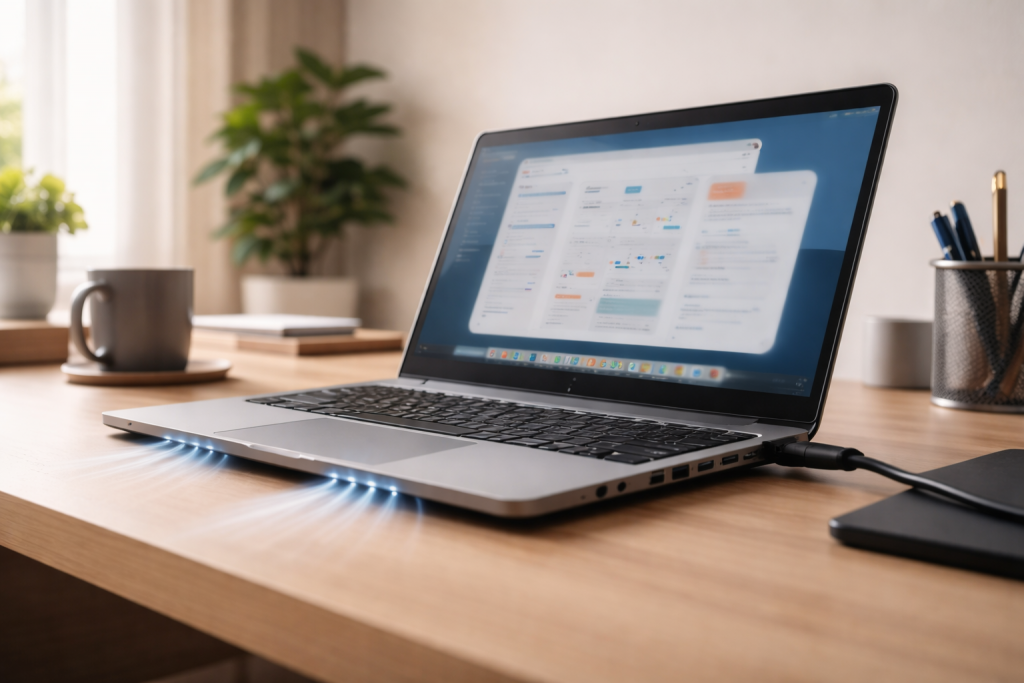
A laptop that sounds like it’s about to take off is rarely “just how it is”. If the fans are loud from the moment you sign in, or they ramp up during basic tasks like email and web browsing, something is pushing heat into the chassis or confusing the fan controller.
The frustrating part is that the machine can feel fast and still be cooking itself. I’ve had Windows laptops on my bench with a perfectly normal CPU temperature reading, yet the fan sat at 70–80% because a single background service kept spiking every few seconds. On Macs, I see the opposite: the system is genuinely hot, but Activity Monitor looks calm until you spot a runaway helper process.
Before you assume it needs a strip-down, treat this like a diagnosis. Fan noise is a symptom. The fix depends on whether you’re dealing with real heat, fake heat (bad sensor/firmware), or a workload that never truly idles.
What actually makes a laptop fan run constantly
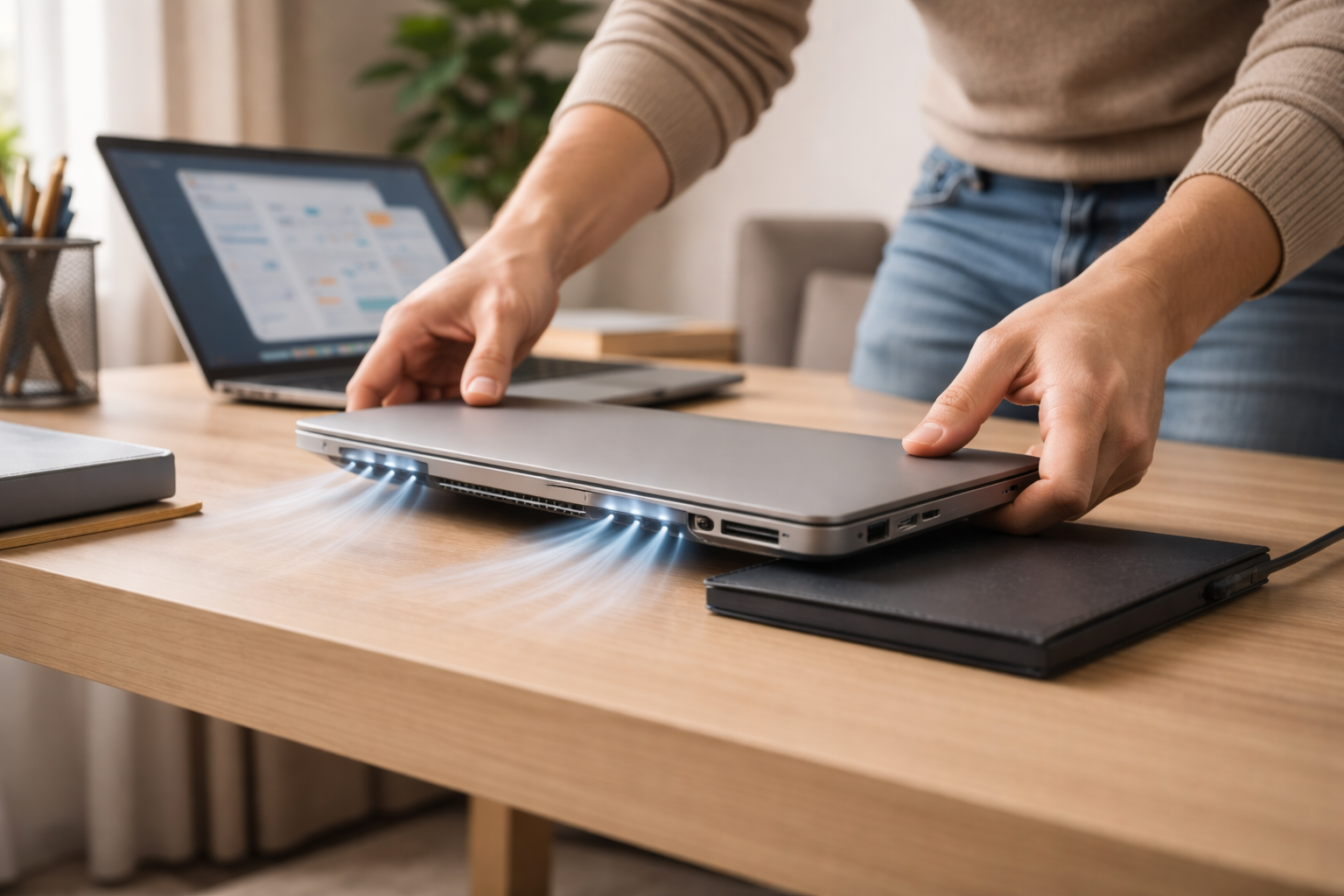
Fans respond to temperature targets set by firmware (BIOS/UEFI on Windows laptops, SMC/firmware on Macs). The operating system influences those targets through power plans, performance modes, and driver-level behaviour, but it doesn’t directly “set the fan speed” on most consumer machines.
Constant fan noise usually comes from one of these failure patterns:
- Persistent background load: indexing, cloud sync, antivirus scans, browser tabs, game launchers, telemetry, or a stuck update process.
- Boost behaviour: modern CPUs spike to high wattage for short bursts. If the cooling system is dusty or the thermal paste is tired, those bursts turn into sustained heat.
- GPU involvement: an external monitor, video decode/encode, or a driver bug can keep the discrete GPU awake even on the desktop.
- Airflow restriction: blocked vents, soft surfaces, pet hair, or a heatsink packed with dust.
- Firmware/driver mismatch: BIOS updates, chipset drivers, and vendor “performance utilities” can fight each other.
- Sensor or fan curve issues: less common, but a faulty temperature sensor or a fan curve that’s too aggressive will make the machine noisy even when cool.
One practical clue: if the fan is loud immediately after boot and stays loud on the login screen, suspect firmware, dust, or a hardware thermal problem. If it’s quiet until you open a browser or plug in a monitor, suspect workload or GPU behaviour.
Fixes that actually move the needle (Windows and macOS)
Work through this in order. The early steps catch the common “software heat” causes. The later steps deal with airflow and firmware, which are slower to check but often the real culprit on older machines.
1) Confirm whether it’s real heat or just noise
- Feel the exhaust: hot air blasting out the side/rear usually means genuine heat. If the air is barely warm but the fan is screaming, think sensor/firmware or a fan curve issue.
- Check surface hotspots: palm rest heat often points to SSD or VRM heat; keyboard centre/top edge points to CPU/GPU.
- Listen for cycling: a repeating ramp-up/ramp-down every 10–30 seconds often means CPU boost bursts or a background task that spikes periodically.
This is the most common issue I see on UK devices sold before 2024: the cooling system is marginal when new, then a year of dust and a couple of aggressive browser updates push it over the edge.
2) Windows: find the process that won’t let the CPU idle
What fails: people look at “CPU 5%” and assume it’s fine. On modern CPUs, 5% can still mean frequent high-wattage bursts that keep temperatures elevated.
- Open Task Manager (Ctrl + Shift + Esc).
- On Processes, sort by CPU, then watch for 2–3 minutes.
- Switch to Details and sort by CPU again. Some offenders hide here.
- Look for patterns: a process that spikes to 10–30% every few seconds is enough to keep fans up.
- If you see Antimalware Service Executable, Windows Modules Installer, or SearchIndexer, let it finish for 20–40 minutes on mains power. If it never settles, that’s a different problem.
If the culprit is a vendor utility (common on gaming laptops), uninstalling it is often cleaner than trying to tame it. Seen most often on HP, Dell and Lenovo laptops with preinstalled “optimisers”.
3) macOS: check for runaway helpers and browser GPU load
- Open Activity Monitor (Applications > Utilities).
- Sort by % CPU and watch for a few minutes.
- If kernel_task is high, don’t assume it’s the cause. It often rises to reduce heat by throttling other processes.
- Check the Energy tab for apps with high “12 hr Power”. Browsers and video apps stand out.
- Quit the top offender, wait 60 seconds, and listen for the fan response.
In practice, quitting one misbehaving browser tab (especially a live video page) fixes the problem in about half of the “my MacBook is loud all the time” cases I’m shown.
4) Stop the “always boosting” behaviour
What fails: leaving the laptop in a high-performance mode on a thin chassis. It will hit its thermal ceiling quickly, then the fan has nowhere to go but loud.
Windows 11/10
- Settings > System > Power & battery.
- Set Power mode to Balanced or Best power efficiency when you don’t need full performance.
- If your laptop has a vendor performance toggle (Fn key, Armoury Crate, Lenovo Vantage, Dell Power Manager), set it to a quieter profile and test again.
Advanced Windows option (useful on stubborn cases)
- Control Panel > Power Options > Change plan settings > Change advanced power settings.
- Processor power management > Maximum processor state: try 99% on mains as a test. This often disables aggressive turbo boost behaviour on some systems.
macOS
- System Settings > Battery.
- Enable Low Power Mode (especially on Intel Macs and fan-cooled Apple Silicon models).
- On some MacBook Pros, check Energy Mode and avoid “High Power” unless you’re doing sustained heavy work.
5) External monitors and docks: the quiet laptop killer
What fails: the laptop is quiet on its own, but the moment you connect USB-C to a monitor or dock, the fans ramp and never come back down. That’s often the GPU staying active, higher refresh rates, or the dock pushing extra power/heat into the chassis.
- Drop the monitor refresh rate to 60Hz as a test.
- Disable HDR temporarily.
- Unplug the dock and connect the monitor directly (or vice versa) to isolate the accessory.
- On Windows, check Task Manager > Performance > GPU. If GPU usage never idles, suspect a driver or display pipeline issue.
If your setup involves USB-C display output, it’s worth cross-checking with Fix external monitor not detected via USB-C because the same driver/dock quirks that break detection can also keep the GPU awake and hot.
6) Update the right things (and avoid the wrong ones)
What fails: updating Windows, but leaving the BIOS and chipset drivers untouched for years. Or installing a random “driver updater” that swaps in generic thermal drivers.
Windows
- Run Windows Update, then check Optional updates for firmware and drivers.
- Update your GPU driver from the manufacturer if you have a discrete GPU. For Nvidia, use Nvidia driver downloads.
- If the fan behaviour changed after a BIOS update, check the laptop maker’s release notes for thermal/fan curve changes and consider rolling back only if the vendor supports it.
macOS
- Install the latest macOS point update available for your version. Apple frequently ships thermal and power management fixes inside these updates.
- If you’re troubleshooting a Mac that became noisy after an update, check Apple’s troubleshooting steps for heat and fans at Apple Support for Mac fan noise and heat.
I’ve seen a few Intel MacBook Pros where a macOS update plus a dusty heatsink turns “fine yesterday” into “jet engine today”. The update isn’t the root cause; it just changes workload patterns enough to expose the cooling margin.
7) Clean airflow properly (without wrecking the fan)
What fails: blasting compressed air into the vent and spinning the fan like a turbine. That can damage bearings or generate back-voltage on some fan circuits.
- Power off completely. Unplug chargers and accessories.
- If you can access the bottom cover easily, remove it and hold the fan blades still while you blow dust out.
- Blow air through the heatsink fins (where the dust mat forms), not just into the intake.
- Check that the exhaust path isn’t blocked by a case, desk mat, or a stand lip.
If you can’t open the laptop, use short bursts of air and change angles. You’re trying to dislodge the felt-like dust layer, not inflate the chassis.
8) When to suspect thermal paste, pads, or a failing fan
What fails: assuming paste is always the answer. On many thin laptops, the bigger issue is dust and poor intake clearance. That said, paste and pads do age, and fans do wear.
- Thermal paste: suspect if the laptop is 3–5 years old, temperatures spike instantly under light load, and cleaning vents doesn’t help.
- Thermal pads: suspect if the chassis gets hot near the SSD/VRM area and the fan ramps even when CPU load is low.
- Failing fan: rattling, grinding, or a pulsing “whoop-whoop” sound. Noise changes when you tilt the laptop slightly.
If you’re not comfortable opening the machine, don’t force it. Stripped screws and torn ribbon cables are common DIY casualties, especially on ultrabooks.
Real-world cases that change the diagnosis
Case 1: Loud only when charging
On many Windows laptops, charging unlocks higher CPU power limits. The machine boosts harder, heats faster, and the fan follows. Test by setting Windows Power mode to Balanced on mains, or temporarily setting Maximum processor state to 99%. If the fan calms down, it’s power limit behaviour rather than a fault. If the chassis still gets unusually hot while charging, cross-check Fix laptop overheating during light daily use.
Case 2: Loud after waking from sleep
This is often a stuck driver or a device that never powers down (Wi‑Fi, Bluetooth, or GPU). On Windows, a full shutdown (Shift + Shut down) is a better test than Restart. On macOS, a normal restart usually clears it. If it keeps happening, look for a specific trigger: docking, external display, or a USB device.
Case 3: Quiet in the morning, loud by afternoon
That pattern points to heat soak: the chassis and heatsink slowly saturate because airflow is marginal. I see it a lot on laptops used on sofas or beds. A stand that lifts the rear edge by even a centimetre can change the fan curve dramatically because the intake stops starving.
Case 4: Fans loud but performance is terrible
That’s often thermal throttling. The fan is working, but the heatsink can’t move heat into the air efficiently (dust mat, poor paste contact, or a warped heatsink). You’ll feel hot exhaust, but the laptop still crawls. At that point, cleaning and a proper repaste (or a service visit) is more realistic than software tweaks.
Errors that keep the fans loud
- Assuming “CPU usage is low” means “CPU power is low”. Short boost spikes can keep temperatures elevated.
- Running “silent mode” plus a heavy workload. The laptop will throttle, then the fan ramps anyway once it hits safety limits.
- Leaving dozens of browser tabs open, especially with live pages. Some tabs keep video decode or WebGL active even when you’re not looking at them.
- Using a soft surface. If the intake is on the bottom, a duvet turns the cooling system into a recirculating oven.
- Installing generic fan control tools on machines that don’t support them. Best case: they do nothing. Worst case: they fight firmware and create oscillating fan behaviour.
- Ignoring docks and chargers. A flaky USB-C dock can add heat and keep the GPU awake.
One thing I’ve learned the hard way: if the fan noise started the same week you changed your desk setup, treat the new monitor/dock/cable as suspect even if everything “works”. Heat problems don’t always break functionality; they just make the laptop miserable.
Hardware and software factors that decide the outcome
Intel vs AMD vs Apple Silicon
Intel thin-and-light laptops (especially 10th–12th gen era) tend to boost aggressively and hit fan thresholds quickly. AMD systems can be better at sustained efficiency, but a bad OEM fan curve still ruins the experience. Apple Silicon Macs are usually quiet, so constant fan noise on an M-series MacBook Pro often points to a specific runaway process, a blocked vent, or a heavy external display workload.
Ambient temperature and UK homes
UK rooms aren’t usually extreme, but small offices with poor airflow can trap heat. If the laptop exhaust points at a wall, it can recirculate warm air. I’ve watched fans calm down just by rotating a laptop 90 degrees so the exhaust isn’t blowing into a shelf panel.
Battery health and charging heat
A worn battery can generate more heat while charging, and some laptops run warmer when the battery is near full and the system is on mains. If you’re also seeing odd charging behaviour, Fix laptop battery draining when plugged in is a useful cross-check because power management faults and fan noise often show up together.
When software is the only realistic fix
If the fan is loud because a specific app is misbehaving, cleaning won’t help. I’ve seen Teams, Chrome, and certain VPN clients keep CPU wakeups high enough to prevent deep idle states. The “fix” is an update, a reinstall, or changing settings (hardware acceleration, background refresh, startup behaviour).
Conclusion
Constant loud fans come from either sustained heat or a system that never truly idles. Start by catching the workload that’s keeping CPU/GPU awake, then tame boost and power modes. If the noise persists, treat airflow as a first-class suspect: dust mats and blocked intakes are boring, but they’re responsible for a lot of “suddenly loud” laptops.
When the exhaust is hot and performance is dropping, stop chasing settings and look at the cooling hardware. A clean heatsink and a healthy fan curve beat any software tweak.
FAQ
Why are my laptop fans always loud after a Windows 11 update even when I’m just on the desktop?
After updates, Windows often runs indexing, Defender scans, and store/app updates in the background. Check Task Manager for SearchIndexer, Antimalware Service Executable, or Windows Modules Installer spiking repeatedly. If it never settles after an hour on mains, look for a third-party utility or driver causing periodic CPU wakeups.
Why does my MacBook fan run loudly when charging but it’s quiet on battery power?
Charging can allow higher sustained power draw, and some workloads (video calls, external displays, browser video) ramp up more on mains. Also, charging itself adds heat inside the chassis. Test with Low Power Mode enabled while charging; if the fan behaviour changes immediately, you’re dealing with power limits rather than a hardware fault.
Why do my laptop fans get loud only when I connect a USB-C dock and external monitor?
USB-C display output can keep the discrete GPU active, increase refresh rate load, or trigger a driver bug that prevents GPU idle. Drop the monitor to 60Hz, disable HDR, and test direct connection versus dock. If GPU usage stays elevated at idle, update the GPU driver and the dock firmware if available.
Why are my fans loud in bed or on the sofa but quieter at a desk?
Soft surfaces block bottom intakes and cause the laptop to recirculate its own hot exhaust. The fan ramps because the heatsink can’t exchange heat efficiently. A hard surface or a stand that lifts the rear edge usually makes an immediate difference.
Why is my laptop fan loud but the air coming out isn’t hot and the laptop feels cool?
That points to a fan curve/sensor/firmware issue or a fan that’s being commanded high due to a misread temperature. It can also happen if a component like the SSD or VRM is hot while the CPU area feels cool. Update BIOS/firmware and chipset drivers first; if the fan also makes mechanical noise (rattle/grind), suspect a failing fan.
Recommended gear on Amazon UK
- Useful for clearing the dust mat from heatsink fins, which is a common reason fans stay loud even at light load. See suitable options
- Lifting the rear edge improves intake airflow and reduces heat soak, especially when the laptop normally sits on soft surfaces. Relevant examples
- Helps confirm whether charging is pushing unusually high wattage into the laptop, which can explain fan ramping on mains. See suitable options
- Relevant when a 3–5 year old laptop spikes to high temperatures instantly and cleaning vents doesn’t change fan behaviour. Comparable items