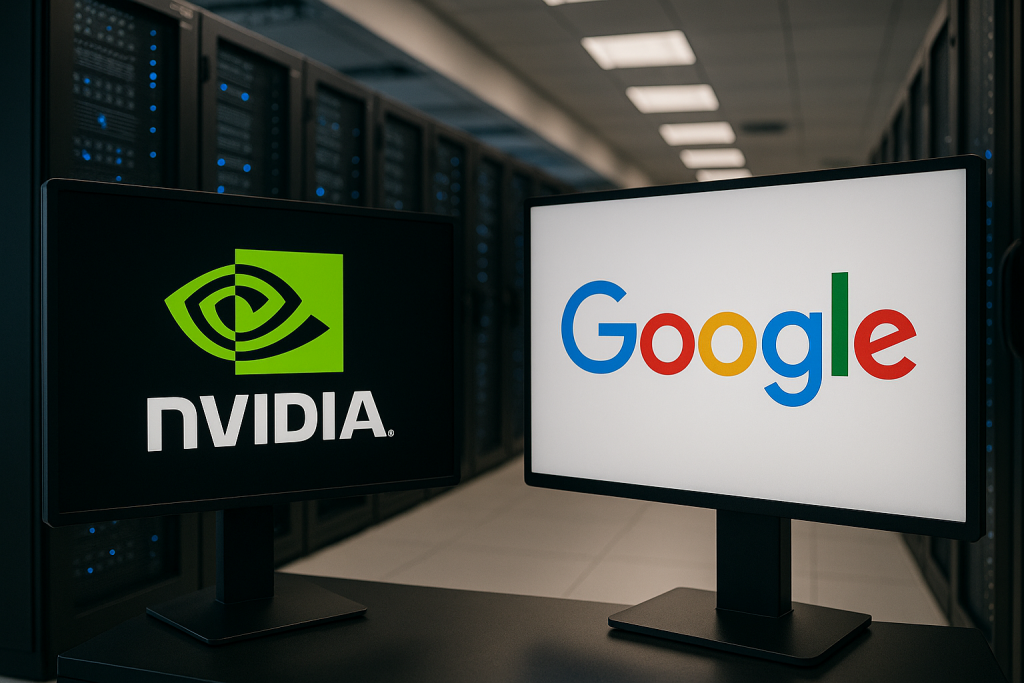
Nvidia’s long-standing dominance in the global AI hardware market is facing its first serious structural challenge in years. Google is now rapidly expanding the real-world deployment of its in-house TPU (Tensor Processing Unit) accelerators as a direct alternative to Nvidia GPUs inside large-scale data centers.
What exactly happened
Over the past months, Google has significantly ramped up the deployment of its latest TPU generations across Google Cloud infrastructure. These accelerators, originally built for internal use, are now increasingly positioned as full-scale competitors to Nvidia’s data-center GPUs for training and inference of large AI models.
Unlike Nvidia, which sells hardware to virtually every cloud provider, Google designs and deploys its own silicon exclusively for its ecosystem. This vertical integration allows tighter optimization between hardware, firmware, AI compilers, and scheduling systems. As a result, selected workloads can now run at significantly lower cost per operation compared to traditional GPU-based pipelines.
Services affected
The shift primarily affects AI model training and inference workloads running inside Google Cloud. Developers using TensorFlow, JAX, and selected PyTorch pipelines can already deploy directly to TPU clusters instead of standard GPU instances.
This gradually reduces Nvidia’s exclusivity inside hyperscale infrastructure. While most third-party clouds still rely heavily on Nvidia hardware, Google’s move signals that internal accelerators are becoming production-ready at global scale rather than experimental prototypes.
Why this matters
Nvidia remains the undisputed leader in AI compute today thanks to its CUDA ecosystem, software maturity, and networking platforms such as NVLink and Infiniband. However, AI energy consumption is exploding, and power efficiency is becoming just as important as raw compute throughput.
If proprietary accelerators like TPU continue gaining traction, the AI hardware market could fragment into multiple specialized platforms. Instead of a single dominant GPU standard, future AI infrastructure may become a hybrid environment composed of GPUs, TPUs, and custom silicon optimized for specific workloads.
This shift mirrors patterns already visible across consumer and networking tech, where infrastructure limits directly impact real-world performance.
What users should do now
For most end users and developers outside Google’s ecosystem, nothing changes immediately. Nvidia GPUs will remain the default standard across most cloud providers, research labs, and enterprise deployments for the foreseeable future.
However, software developers working with Google Cloud should monitor TPU compatibility closely. Optimizing models for TPU may soon become a competitive advantage in cost-sensitive AI deployments.
For businesses investing in AI infrastructure, diversification is becoming strategically important. Relying on a single vendor for long-term compute capacity is no longer a risk-free decision.
Related on FixGearTech
How to Fix Wi-Fi 7 Interference With Smart Home Devices (2026)
The AI hardware market is no longer a one-horse race. Competition between proprietary accelerators and GPUs is accelerating, and the winners will be determined not only by performance, but by efficiency, ecosystem control, and long-term operating costs.