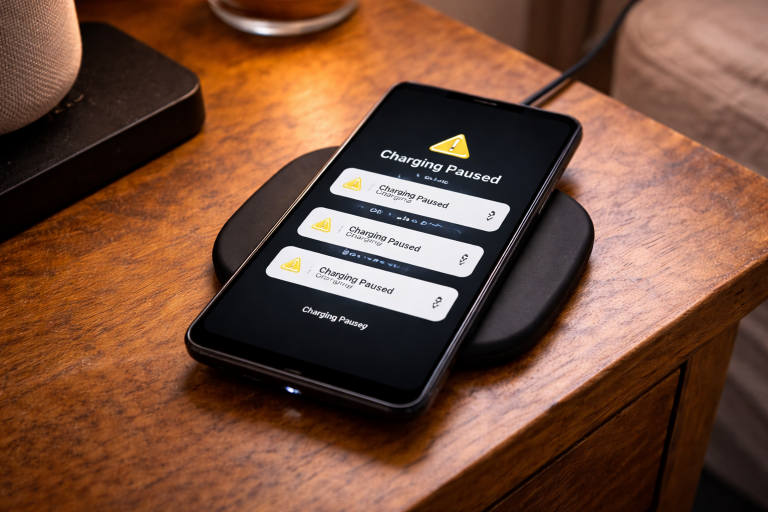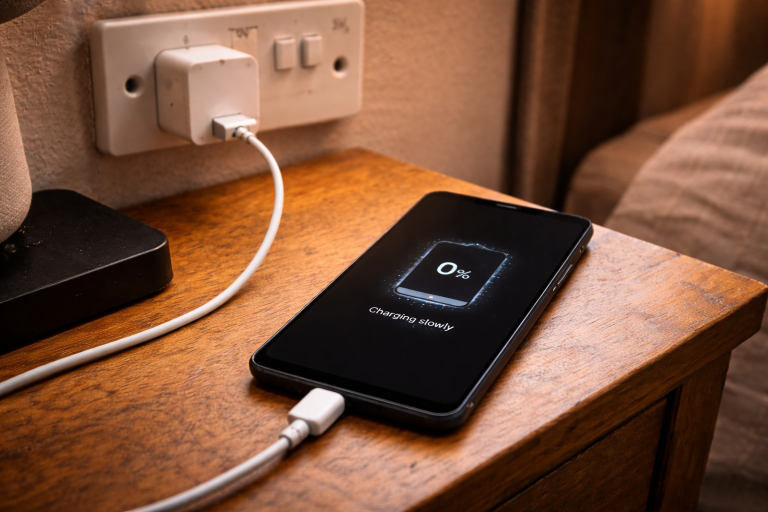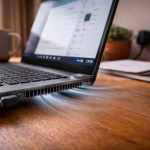
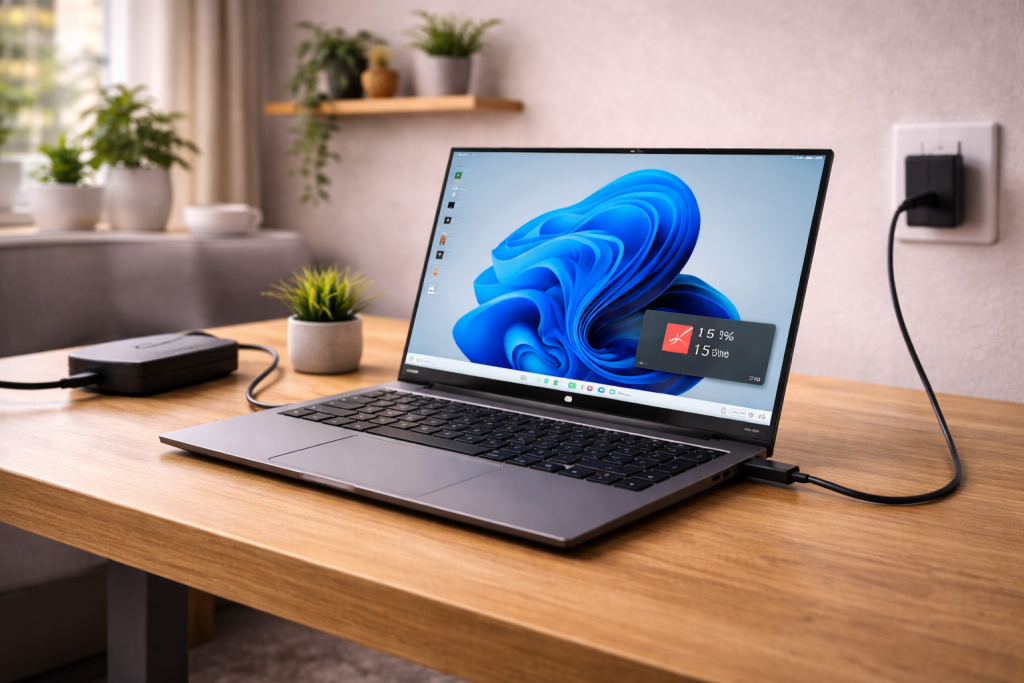
You plug the laptop in, the charging icon appears, and yet the battery percentage slides down anyway. Sometimes it only happens under load (video calls, games, compiling code). Other times it drains slowly all day, even with nothing obvious running. It feels like the mains power is being ignored.
Most of the time, the laptop is taking power. The problem is that it is not taking enough power to cover what the system is using, so the battery quietly makes up the difference. On modern USB-C laptops this is common: the charger negotiates a lower wattage than expected, a dock caps delivery, or the machine is throttling charge because it is hot.
I see this a lot on UK laptops that ship with USB-C charging and a small 45W adapter, then get paired with a random 30W phone charger or a dock that only passes 60W. It “works”, but the battery still drains during real work.
What’s actually happening when a laptop drains on mains
A laptop has a power budget. The CPU, GPU, screen, storage, Wi-Fi, and USB devices draw power. The charger supplies power. If supply is lower than demand, the battery becomes a buffer and discharges even while “plugged in”. That’s not a software bug; it’s basic power accounting.
There are a few distinct patterns behind the same symptom:
- Undersized or non-compliant charger: USB-C Power Delivery (PD) negotiation falls back to 5V/9V/15V at low current, or the adapter is simply too low wattage for the laptop.
- Dock/monitor bottleneck: USB-C docks and USB-C monitors often pass less power than the laptop expects. Some advertise 100W but only deliver that with a specific PSU.
- Battery protection behaviour: Many laptops pause or slow charging at high temperatures, or hold at 80% with “battery health” modes. Under load, that can look like draining.
- DC-in/USB-C port issues: Worn barrel jack, loose USB-C port, debris, or a damaged cable causes intermittent power drops. The OS may still show “plugged in” because it flickers too quickly to notice.
- Firmware/driver power limits: BIOS/UEFI settings, EC (embedded controller) quirks, or USB-C PD firmware can cap input power until updated.
One detail matters: if the battery drains only during heavy load, suspect a power budget mismatch. If it drains even at idle, suspect a charging path fault, a negotiation failure, or a battery that can’t accept charge properly.
Pinpoint the cause with a disciplined check sequence
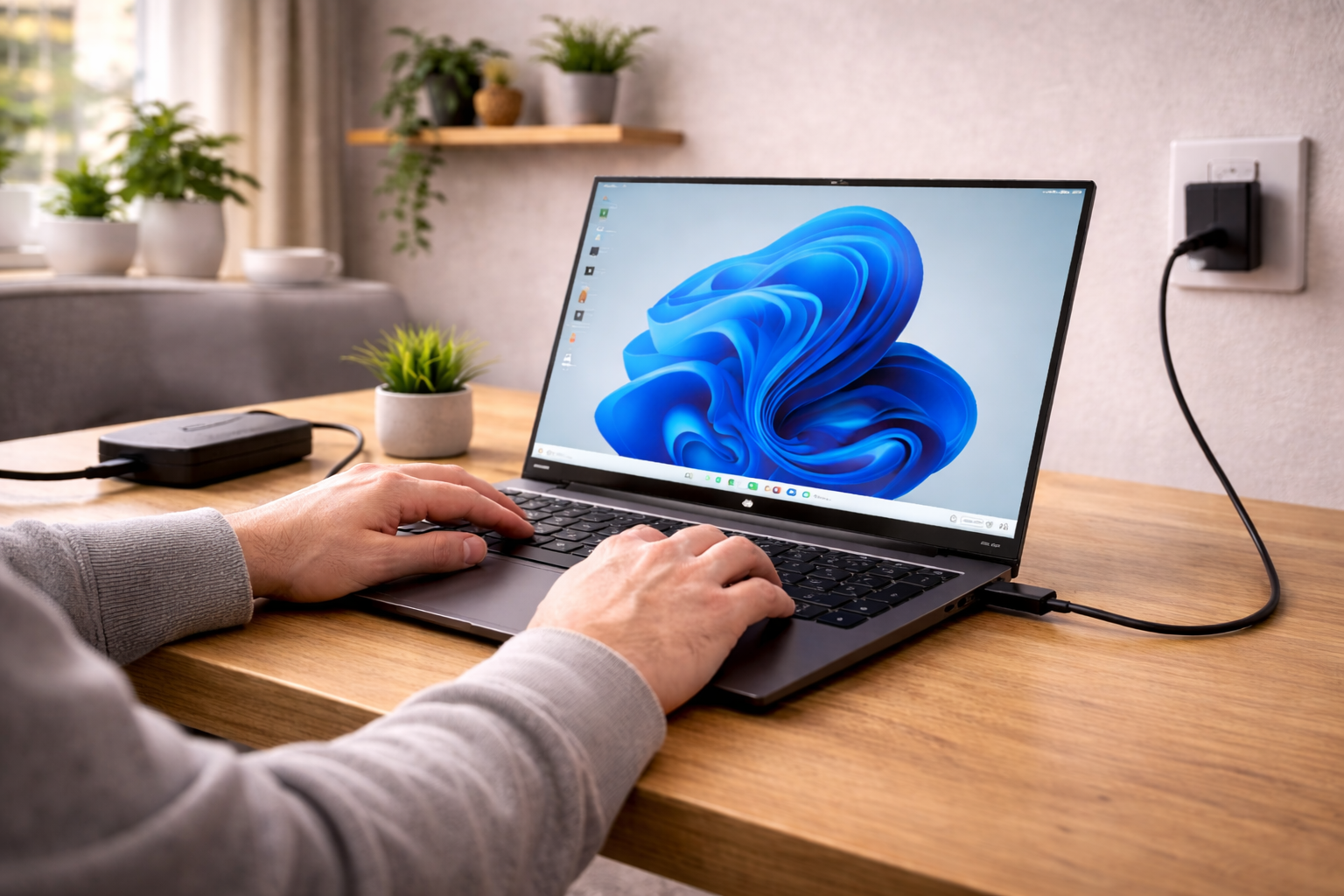
Start by proving whether the laptop is receiving the expected wattage. Don’t jump straight to reinstalling drivers; it wastes time when the root cause is a 30W charger.
1) Confirm the charger is the right type and wattage
- Read the laptop’s required wattage: usually printed on the original adapter, the underside label, or the manufacturer spec. Common values: 45W, 65W, 90W, 100W, 130W, 180W, 230W.
- Check the adapter output: on USB-C PD adapters, look for profiles like 20V⎓3.25A (65W) or 20V⎓5A (100W). If the highest profile is 15V⎓3A (45W), that’s a ceiling.
- Match the cable to the wattage: 100W (and above, on newer standards) needs an e-marked cable. A cheap USB-C cable can silently cap at 60W or less.
Seen most often on HP, Dell and Lenovo laptops: the user swaps the original charger for a phone charger that can do “fast charging”, but only at 9V. The laptop accepts it, then drains under any meaningful load.
2) Eliminate docks, hubs and monitors as the middleman
- Unplug the dock/USB-C monitor.
- Connect the charger directly to the laptop.
- Use the laptop for 10–15 minutes doing the thing that normally triggers drain (Teams call, game menu, export, etc.).
If the drain stops, the dock/monitor is your limiter. Many USB-C monitors in particular advertise power delivery but top out at 45W–65W, which is fine for ultrabooks and hopeless for gaming laptops.
3) Check whether the laptop is throttling charging due to heat
- Feel the palm rest and underside near the battery area. Warm is normal; hot enough that you don’t want to keep your hand there is not.
- Listen for fans ramping hard while the battery drops.
- Move the laptop onto a hard surface for airflow and retest.
In practice, heat-related charge throttling is the “it only happens on the sofa/bed” case. I’ve watched a thin laptop hold at 79–80% on mains, then dip to 75% during a long call because the chassis heat triggers battery protection.
4) Look for obvious power-hungry culprits before blaming the battery
- Windows: open Task Manager and sort by CPU, then GPU. If a browser tab is pegging the GPU, your power draw jumps.
- macOS: check Activity Monitor for high CPU and “Energy” impact.
- Disconnect external drives and USB devices temporarily. Bus-powered SSDs can add a few watts continuously.
This step matters because a marginal charger (say 45W) might be fine at idle but not with a 20W spike from CPU boost plus a bright screen.
5) Verify the laptop is actually charging, not just detecting a plug
- Watch the battery percentage for 5 minutes at idle with screen brightness at 30–40%.
- If it still drops, try a different wall socket and remove any extension lead.
- Wiggle-test the connector gently. If the charge indicator flickers, you’ve found a physical issue.
UK extension leads with worn switches cause more weird charging behaviour than people expect. The laptop sees brief drops, then the battery fills the gaps.
Targeted fixes that address the real failure modes
Once you’ve narrowed it down, apply the fix that matches the failure. Mixing fixes at random makes it harder to know what worked.
Fix A: Replace the charger with one that meets the laptop’s peak draw
- If your laptop shipped with 65W, don’t “upgrade” to a 45W travel adapter and expect stability under load.
- For USB-C laptops, use a PD charger that supports 20V at the required current (3.25A for 65W, 5A for 100W).
- If your laptop uses a proprietary barrel adapter (common on gaming/workstation models), use the correct OEM wattage. Many will run on a lower wattage adapter but drain the battery during gaming.
Edge case: some laptops accept USB-C charging but only up to a certain limit (for example, they’ll run on 65W USB-C but need 180W barrel for full performance). In that situation, battery drain during heavy use is expected behaviour, not a fault.
Fix B: Stop the dock from starving the laptop
- Check the dock’s rated upstream power delivery (PD). If it’s 60W and your laptop wants 90W, that mismatch is the story.
- Use the dock’s proper PSU (some ship with a weak one).
- Where possible, power the laptop directly and use the dock only for data (not ideal, but it isolates the issue).
If you’re using a USB-C dock and charging is flaky, cross-check with Fix laptop not charging via a USB-C dock (UK models). The symptoms overlap, but “draining while plugged in” is often the same root cause one step earlier.
Fix C: Correct Windows power mode and vendor battery settings
- Set Windows power mode to Balanced while you test. “Best performance” can keep boost clocks high and raise draw.
- Open your manufacturer utility (Lenovo Vantage, Dell Power Manager, HP Support Assistant, ASUS MyASUS) and check for Battery Conservation or Charge Limit modes.
- If a charge limit is enabled (often 80%), confirm whether the laptop is holding at that level or actually dropping below it under load.
A charge limit isn’t a bug. The confusion happens when the laptop holds at 80%, then a heavy workload pulls it down to 76–78% before the controller allows charging again. That looks like “draining while plugged in”, but it’s the control loop doing its job.
Fix D: Update firmware that controls charging and USB-C PD
- Update BIOS/UEFI from the laptop maker, not from random driver sites.
- Update chipset and USB-C/Thunderbolt drivers if your model uses them.
- On Windows, check official guidance for power and battery reporting: Windows battery and power troubleshooting
This is the most common issue I see on UK devices sold before 2024 that later get USB-C docks: older firmware negotiates PD poorly with newer chargers and falls back to a lower profile.
Fix E: Recalibrate battery reporting (only when the numbers look wrong)
Battery calibration won’t fix a charger that’s too weak. It does help when the percentage drops rapidly from, say, 40% to 10% and then sits there for ages, or when the laptop shuts down at 20%.
- Charge to 100% and leave it on mains for 30–60 minutes.
- Use the laptop on battery down to around 10–15% (avoid 0% if possible).
- Charge back to 100% uninterrupted.
If the laptop still drains on mains after calibration, you’re back to power delivery, heat, or a failing battery pack.
Fix F: Inspect and clean the charging path
- For USB-C: check the port for lint. Pocket fluff can stop full insertion and cause intermittent contact.
- Try a different USB-C port if your laptop has more than one (some are data-only, some are PD-capable).
- For barrel jacks: check for looseness. If the plug feels sloppy, the DC-in jack may be worn.
I’ve had machines where the battery “drained while plugged in” only when the laptop was moved. The connector was making contact, but not consistently enough to sustain charge.
Situations that change the diagnosis
Same symptom, different cause. These patterns save time.
Gaming laptop drains even with the original charger
Some gaming laptops are designed to supplement the adapter with battery during short spikes (CPU+GPU boost). If it drains steadily during gaming and never recovers on mains, that’s not normal. Check for:
- Wrong adapter wattage (common after replacements).
- Adapter overheating and derating (brick too hot to touch is a clue).
- Performance mode forcing sustained high draw.
Also watch for a GPU driver update that changes boost behaviour. A small uplift in sustained power can push a borderline adapter into deficit.
Ultrabook drains only on USB-C monitor power
USB-C monitors often provide 45W–65W. That’s fine until you run the screen at full brightness, charge a phone from the laptop, and push video over USB-C. The monitor’s PD budget is now split across multiple functions.
- Disable laptop-to-phone charging temporarily.
- Lower screen brightness and retest.
- Use a direct laptop charger instead of relying on monitor PD.
Battery drops from 100% to 95% and then holds
That’s usually normal battery care logic. Many laptops avoid sitting at 100% constantly. They’ll let it drift down a few percent, then top up. If it keeps falling past 90% while idle on mains, treat it as a fault.
It drains faster when plugged into a car inverter
Cheap inverters produce noisy power and can’t sustain the adapter’s peak draw. The adapter may run hotter and deliver less. If you need reliable charging in a vehicle, a proper USB-C PD car charger with the correct wattage is often more stable than an inverter plus a wall brick.
Errors that waste hours (and sometimes damage ports)
- Assuming “USB-C is USB-C”: cables and chargers vary wildly. A data cable can look identical to a 100W e-marked cable.
- Testing with a nearly empty battery only: some laptops charge aggressively at low percentages and then taper. Test at 30–80% as well.
- Ignoring the dock PSU: a dock with a weak power brick will still light up and pass data, while starving the laptop.
- Leaving the laptop on a duvet: heat makes charging logic conservative. The symptom appears “only when plugged in” because that’s when the system is working hardest.
- Forcing connectors: if USB-C feels tight or gritty, stop. Bent pins or damaged ports turn a solvable power issue into a board repair.
One I keep seeing: users swap to a longer USB-C cable for desk tidiness. The longer cable has higher resistance, voltage droops under load, PD renegotiates down, and the battery starts draining. Nothing looks obviously broken.
Hardware and software factors that decide whether it can be fixed
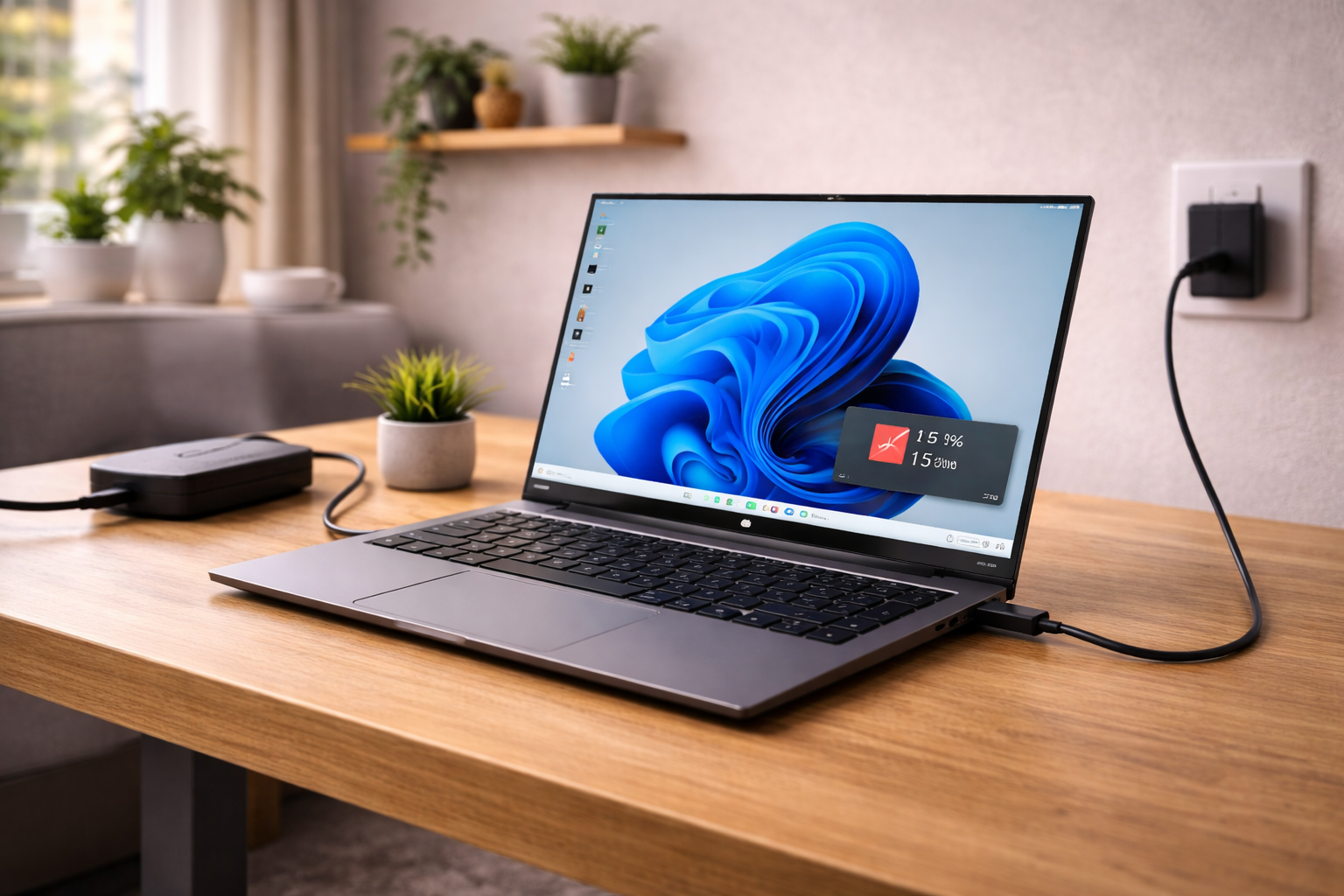
Sometimes the laptop is behaving correctly and the setup is the problem. Other times the battery or charging circuitry is genuinely failing.
Battery health and internal resistance
A worn battery can show odd behaviour on mains. If the pack has high internal resistance, it may not accept charge properly under heat or load, and the percentage can drift down. On Windows, a battery report can help you see design capacity versus current capacity. On macOS, System Information shows cycle count and condition.
If the laptop is more than a few years old and the battery drains on mains even at idle, a failing pack is a realistic culprit. It’s not the first thing I replace, but it’s often the final answer on machines that have lived on charge 24/7.
USB-C PD limits and proprietary charging modes
Some brands support higher-than-standard charging only with their own adapters, or only via a specific port. Others will accept USB-C PD but cap performance to protect the adapter. That can look like “battery drain”, but it’s really “system draw exceeds negotiated PD”.
If you’re mixing chargers, it’s worth reading the manufacturer’s charging notes. Apple’s guidance on power adapters and USB-C charging behaviour is a good reference point even if you’re on Windows hardware: USB-C power adapters and charging basics.
Windows Modern Standby and background load
Modern Standby can keep the system semi-awake, doing updates and syncing. If you close the lid expecting it to sip power, but it keeps working, the laptop may warm up and then charge more slowly. You notice it as “it was plugged in all night and still dropped”.
If your laptop is hot in a bag after sleep, fix that first. Battery drain while plugged in can be a secondary symptom of a sleep problem. Related power oddities also show up as random USB dropouts; Fix USB devices randomly disconnecting is worth a look if you see both.
Where I’d land after diagnosing a real laptop on the bench
If the battery drains on mains only under load, I treat it as a power budget mismatch until proven otherwise: charger wattage, cable rating, dock PD limit, or a monitor that can’t keep up. That’s the fast win in about half of cases.
If it drains at idle, I stop trusting the charging path. I’ll test with a known-good OEM adapter, bypass all docks, and check for connector instability. If it still drops, then it’s firmware, battery health, or a board-level charging fault.
Once you know which bucket you’re in, the fix is usually straightforward. The frustrating part is that the UI often says “plugged in” even when the laptop is negotiating 27W and quietly burning 40W.
FAQ
Why does my laptop battery go down when it’s plugged in during a Teams call on Wi-Fi?
Video calls can push CPU boost, camera processing, Wi-Fi activity and screen brightness at the same time. If your charger or USB-C dock is delivering less wattage than the laptop is using, the battery fills the gap and the percentage drops. Test by plugging the charger directly into the laptop (no dock) and lowering the power mode to Balanced to see if the drain stops.
Why does my laptop charge at 80% but then slowly drains when I keep it plugged in all day?
That’s often a battery conservation feature holding the charge around 80% for longevity. Under load, it may allow a small drop before topping up again. If it keeps falling well below the limit while idle, check for heat (charging throttled) or a low-wattage charger that can’t cover background load.
Why does my laptop battery drain when plugged into a USB-C monitor but not with the original wall charger?
The monitor’s USB-C Power Delivery output is usually capped (commonly 45W–65W). Your laptop may need more than that once you add screen brightness, external peripherals and video output over the same cable. The original wall charger likely supplies 65W–100W (or more), so it keeps up. Bypass the monitor PD and power the laptop directly to confirm.
Why does my gaming laptop lose charge while plugged in even though it says “charging” in Windows?
Gaming loads can exceed what the adapter can supply if the charger wattage is wrong, the adapter is overheating and derating, or the laptop is set to an aggressive performance mode. Some models also use the battery to smooth short power spikes, but it should recover afterwards on mains. If it never recovers, verify you’re using the correct OEM wattage and a healthy cable/connector.
Why does my laptop battery drain overnight when it’s plugged in with the lid closed in a backpack?
If the laptop doesn’t enter proper sleep and instead stays in a low-power active state, it can run warm in an enclosed space. Heat can slow or pause charging, and background tasks can keep power draw above what the charger delivers. Check for sleep issues (hot chassis is a giveaway), then retest charging on a hard surface with good airflow.
Recommended gear on Amazon UK
- A properly rated PD charger prevents the common situation where a 45W–65W adapter can’t cover CPU/GPU spikes, so the battery drains even though the laptop shows it’s plugged in. Relevant examples
- An e-marked cable avoids silent wattage caps and voltage drop that can force USB-C Power Delivery to negotiate down, especially with longer cables on desks. Relevant examples
- A USB-C power meter lets you see the negotiated voltage and watts in real time, which is the quickest way to prove whether the dock, monitor or charger is the bottleneck. See suitable options
- Extra airflow reduces heat-triggered charge throttling, a pattern that shows up when laptops are used on soft furnishings and then appear to ‘drain while charging’. See suitable options