
If your iPhone keeps dropping off Wi‑Fi at home while everything else stays online, the fault is usually a mix of router settings, interference and iOS quirks rather than a single obvious bug. This guide walks through the fixes that consistently stabilise iPhones on UK home networks, including BT, Sky and Virgin hubs.
Recognising the iPhone Wi‑Fi Drop Problem
Before changing settings, confirm you are dealing with a genuine Wi‑Fi stability issue and not a broadband outage or app problem.
Typical symptoms on iPhone
- Wi‑Fi icon disappears and reappears every few minutes while you are at home.
- FaceTime, WhatsApp or Teams calls freeze or drop even when you are near the router.
- Streaming apps like Netflix or YouTube suddenly switch to mobile data and show lower quality.
- Speed tests jump between strong Wi‑Fi speeds and very slow or failed tests.
- Other devices (laptops, tablets, TVs) stay connected to the same Wi‑Fi without issues.
When I see this pattern, the iPhone is almost always fighting with the router over band steering, power saving or a marginal signal rather than a total broadband failure.
Quick checks before deep troubleshooting
- Confirm your broadband is actually up by testing another device on the same Wi‑Fi.
- Check if the issue happens only on your home network or also on work / public Wi‑Fi.
- Note whether it happens in specific rooms or everywhere in the house.
- Check if it affects one iPhone or multiple iPhones in the home.
If only one iPhone is affected and it drops on every network, you are likely dealing with a device‑side issue. If multiple iPhones only misbehave on your home Wi‑Fi, the router configuration is usually the culprit.
Why iPhones Randomly Drop Wi‑Fi on Home Routers
Most random disconnects come from a combination of iOS power management, band steering between 2.4 GHz and 5 GHz (or 6 GHz on newer routers), and aggressive router features like Smart Setup or Smart Wi‑Fi.
Band steering and roaming conflicts
Modern routers often broadcast the same network name (SSID) on 2.4 GHz and 5 GHz, and sometimes 6 GHz. They then try to push devices to the “best” band automatically. iPhones are quite aggressive at roaming between bands and access points, which can cause brief disconnects when the router and phone disagree.
This is most visible on mesh systems or ISP routers with “Smart” Wi‑Fi features enabled, where the iPhone jumps between nodes or bands as you move around the house. In practice, this step is behind a lot of “Wi‑Fi keeps dropping when I walk upstairs” complaints on iPhones paired with cheap mesh kits.
Power saving and Private Wi‑Fi Address behaviour
iOS uses several tricks to save power and improve privacy, including Private Wi‑Fi Address and MAC randomisation. Some older or badly configured routers do not handle frequent MAC changes or sleep/wake transitions cleanly, so the iPhone gets kicked off or fails to renew its IP address.
On some ISP routers, DHCP lease times are set very low or the router firmware has bugs around sleeping devices, which shows up as random disconnects after the phone has been idle for a while.
Interference and weak signal zones
2.4 GHz is crowded in UK homes, especially in flats with many neighbours. Baby monitors, cheap smart plugs, microwaves and older cordless phones all add noise. A marginal signal combined with interference often looks like random drops, especially when you move between rooms.
5 GHz and 6 GHz avoid some of this, but they have shorter range and struggle through thick walls or older brickwork. I rarely see stable 5 GHz coverage in UK Victorian terraces without at least one extra access point or mesh node.
Router firmware and ISP features
BT, Sky and Virgin routers ship with a lot of automatic features enabled by default: Smart Setup, Smart Wi‑Fi, band steering, parental controls and guest networks. These can clash with iOS features like Wi‑Fi Assist, Private Relay and iCloud services.
If your iPhone only misbehaves on your ISP router but works fine on a separate third‑party router or hotspot, firmware quirks are usually to blame. In those cases, disabling a few “smart” options or adding a dedicated router often stabilises everything.
Step‑by‑Step Fixes on the iPhone Itself
Start with changes on the iPhone. These are quick to test and often resolve the issue without touching the router.
1. Turn Wi‑Fi off and on properly
Control Centre toggles can leave Wi‑Fi in a half‑disabled state. Always reset Wi‑Fi from Settings first.
- Open Settings > Wi‑Fi.
- Toggle Wi‑Fi off, wait 10 seconds, then toggle it back on.
- Reconnect to your home network and watch for drops over a few minutes.
This simple reset clears minor Wi‑Fi stack glitches that appear after long uptimes or iOS updates.
2. Forget and re‑add your home network
Corrupt or outdated Wi‑Fi profiles cause a lot of random disconnects, especially after router changes or ISP upgrades.
- Go to Settings > Wi‑Fi.
- Tap the i icon next to your home network.
- Tap Forget This Network and confirm.
- Turn Wi‑Fi off and on again.
- Select your home network, re‑enter the password and connect.
In practice, this step fixes the problem in about half of cases where the router password or security mode has been changed recently.
3. Disable Wi‑Fi Assist and test
Wi‑Fi Assist automatically switches to mobile data when Wi‑Fi is weak. On flaky networks this can look like Wi‑Fi randomly dropping, especially during calls or streaming.
- Open Settings > Mobile Data.
- Scroll to the bottom.
- Toggle Wi‑Fi Assist off.
Use your phone normally for a day. If the drops stop but you see slower speeds in weak spots, the issue was more about marginal coverage than a hard disconnect.
4. Turn off Private Wi‑Fi Address for your home network
Some ISP routers and older smart home setups do not like MAC randomisation. Disabling it for your home network only can stabilise things without sacrificing privacy elsewhere.
- Go to Settings > Wi‑Fi.
- Tap the i next to your home network.
- Toggle Private Wi‑Fi Address off.
- Tap Rejoin if prompted.
I see this fix most often on Virgin and older BT hubs where DHCP reservations or parental controls are tied to a specific MAC address.
5. Reset network settings on the iPhone
If you have tried the above and still see random drops, reset all network settings on the device. This clears Wi‑Fi, VPN, APN and Bluetooth configurations.
- Open Settings > General.
- Tap Transfer or Reset iPhone.
- Tap Reset > Reset Network Settings.
- Enter your passcode and confirm.
- After reboot, reconnect to your home Wi‑Fi from scratch.
This is the most common issue I see on devices sold in the UK before 2024 that have been upgraded through multiple iOS versions without a clean setup.
6. Update iOS and check for known Wi‑Fi bugs
Apple regularly fixes Wi‑Fi issues in point releases. Always test on the latest available iOS version for your device.
- Go to Settings > General > Software Update.
- Install any available update.
- After updating, repeat a basic Wi‑Fi test near the router and in your usual problem room.
For detailed change notes, refer to Apple’s official iOS Wi‑Fi and networking support articles.
Router and Home Network Fixes for Unstable iPhone Wi‑Fi
If multiple iPhones struggle only on your home network, focus on the router. ISP routers in the UK are often configured for simplicity, not stability under heavy device loads.
7. Reboot and, if needed, power‑cycle the router
Start with a clean reboot to clear memory leaks and stuck processes.
- Unplug the router and any separate modem from the mains.
- Wait at least 30 seconds.
- Plug the modem back in (if separate) and wait until all lights stabilise.
- Plug the router back in and wait for Wi‑Fi to come back.
- Reconnect your iPhone and test for 10–15 minutes.
In real homes, not lab setups, a simple power‑cycle often clears weeks of minor glitches that only show up on more sensitive devices like iPhones.
8. Separate 2.4 GHz and 5 GHz network names
To stop the iPhone bouncing between bands, give 2.4 GHz and 5 GHz their own SSIDs instead of one combined name. The exact steps vary by router, but the principle is the same.
- Log into your router’s web interface or app (BT, Sky, Virgin, etc.).
- Find the Wireless or Wi‑Fi settings section.
- Disable “Smart” or “Combined” SSID if present.
- Set a clear name for 2.4 GHz (for example, Home24).
- Set a different name for 5 GHz (for example, Home5G).
- Use the same password for both for convenience.
After this, connect the iPhone to the 5 GHz network when you are near the router and test stability. If you still see drops far from the router, try the 2.4 GHz network in those rooms and compare.
9. Turn off Smart Setup / Smart Wi‑Fi features
BT, Sky and Virgin often enable onboarding or “helper” features that interfere with normal traffic, especially on iOS devices.
- On BT hubs, disable Smart Setup in the router interface.
- On Sky and Virgin, look for options like Smart Wi‑Fi, Band Steering or Wi‑Fi Optimisation and turn them off temporarily.
- Disable any trial parental control or security add‑ons that inspect traffic.
Once these are off, test the iPhone again for at least a day. I often see unstable behaviour stop at this point when cheaper ISP routers were trying to be too clever.
10. Check for router firmware updates
Most ISP routers update automatically, but some third‑party routers and mesh systems need manual checks.
- Open your router’s web interface or app.
- Look for a Firmware, Software Update or Maintenance section.
- Apply any available update and allow the router to reboot.
- Retest the iPhone after the update completes.
On Wi‑Fi 7 and 6E routers, early firmware is often buggy with iOS devices; later updates usually improve roaming and stability. For more advanced tuning, see our guide to setting up Wi‑Fi 7 at home for minimal interference.
11. Adjust channel and bandwidth settings
If neighbours are on the same channels, your iPhone may see more drops than less sensitive devices. Manually choosing channels can help.
- In router Wi‑Fi settings, set 2.4 GHz to channels 1, 6 or 11 only.
- Set 2.4 GHz channel width to 20 MHz for stability.
- On 5 GHz, avoid DFS channels if your router allows manual selection; pick a mid‑range channel like 44 or 100.
- Set 5 GHz channel width to 40 or 80 MHz, not 160 MHz, for better compatibility.
This often fails on budget MediaTek chipsets in ISP routers that ignore manual channel choices, but it is worth trying on third‑party gear.
12. Check DHCP range and IP conflicts
If the DHCP range is too small or you have static IPs overlapping with the automatic pool, devices can fight over addresses and drop off.
- In the router’s LAN or DHCP settings, confirm the DHCP range is at least 50–100 addresses (for example, 192.168.1.50–192.168.1.200).
- Remove any old DHCP reservations for devices that no longer exist.
- If you use static IPs, ensure they sit outside the DHCP range.
In practice, I see IP conflicts more often in homes with lots of smart plugs, bulbs and cameras where the default DHCP range was never increased.
Real‑World Scenarios and How They Were Fixed
Case 1: iPhone drops Wi‑Fi only upstairs
A common pattern in UK semi‑detached houses is solid Wi‑Fi downstairs near the router and constant drops upstairs. The iPhone clings to a weak 5 GHz signal instead of switching cleanly to 2.4 GHz.
Separating SSIDs and connecting the iPhone to 2.4 GHz upstairs usually stabilises things. Adding a single wired or powerline‑backhauled access point on the landing often removes the problem entirely.
Case 2: Only one iPhone in the house has issues
When one iPhone drops while others are fine, the fault is usually on the device. In one setup, an older iPhone SE kept dropping on every network while newer iPhones stayed solid.
A full network settings reset, disabling Private Wi‑Fi Address on the home network and updating to the latest iOS version stopped the drops. The same steps failed on a different device that later turned out to have a hardware Wi‑Fi fault, confirmed by Apple diagnostics.
Case 3: All Apple devices unstable on a new router
After upgrading to a Wi‑Fi 6 mesh kit, one household saw iPhones, iPads and Macs randomly disconnect while Windows laptops were fine. The mesh system had aggressive band steering and DFS channels enabled by default.
Disabling band steering, locking 5 GHz to non‑DFS channels and giving each band its own SSID stabilised the Apple devices. This is a pattern I see often when people replace ISP routers with mesh systems but leave all the “auto” settings enabled.
Common Mistakes That Keep iPhone Wi‑Fi Unstable
Leaving everything on automatic forever
Automatic channel selection, band steering and smart optimisation are fine until your environment changes. New neighbours, extra smart devices or a new mesh node can tip a previously stable setup into chaos.
Once you see regular drops, assume the auto settings are no longer optimal and start locking down channels, bands and SSIDs.
Blaming broadband speed instead of Wi‑Fi quality
Many users focus on Mbps numbers from speed tests and ignore signal strength and stability. A 50 Mbps connection with a clean, steady Wi‑Fi link feels far better than a 500 Mbps line with constant retries and drops.
If your iPhone disconnects while other devices stay online, the issue is almost never your ISP’s backhaul speed. It is the local wireless environment and how the iPhone interacts with it.
Using only the ISP router in large or thick‑walled homes
BT, Sky and Virgin routers are built to be “good enough” in small to medium homes. In larger properties or older brick houses, they rarely provide stable coverage to every room.
In those cases, adding proper access points or a well‑configured mesh system is more effective than endlessly rebooting the ISP hub. Our Wi‑Fi 7 interference guide covers how newer routers can clash with smart home gear if placed badly.
Hardware and Configuration Upgrades That Actually Help
When to add a better router or access point
If you have more than 20 wireless devices, multiple floors and thick walls, a single ISP router is usually not enough. A dedicated Wi‑Fi 6 or Wi‑Fi 7 router with proper antennas and better firmware handles roaming and interference more gracefully.
Switching to this type of hardware resolves problems commonly seen in similar setups where iPhones drop while cheaper smart plugs stay connected.
Mesh systems vs single high‑end router
Mesh systems are useful in long or multi‑storey homes, but only if the nodes are placed with good backhaul links. A poorly placed mesh node with a weak backhaul will make iPhone drops worse, not better.
In smaller flats, a single well‑positioned high‑end router often beats a three‑node mesh kit. I rarely see mesh outperform a solid central router in compact UK new‑build flats.
Charging and cabling considerations
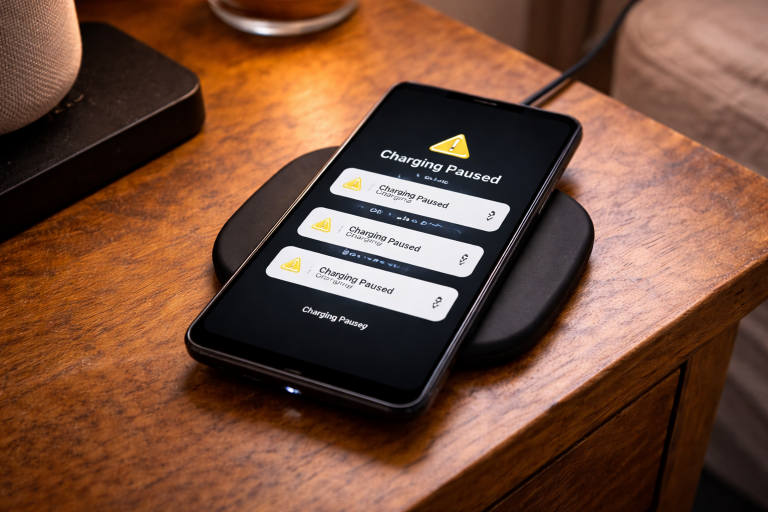
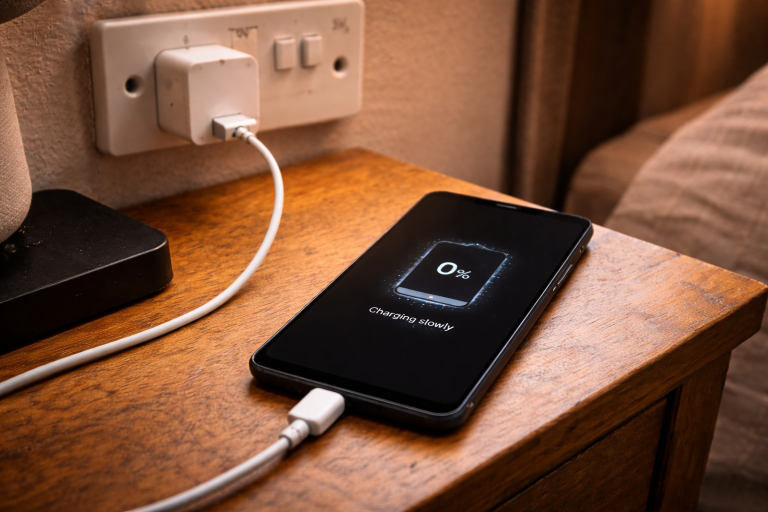
While not directly related to Wi‑Fi, unstable power or cheap chargers can cause random reboots and odd behaviour that looks like network drops. If your iPhone only misbehaves when charging in a specific room, test with a different charger and cable.
In practice, issues like this often come down to the cable itself rather than the device, especially with worn or frayed USB‑C to Lightning leads. A reliable USB‑C power adapter paired with a good cable removes one more variable from the troubleshooting chain.
Conclusion: Stabilising iPhone Wi‑Fi in Real Homes
Random Wi‑Fi disconnects on iPhone are usually the result of several small issues stacking up: band steering, interference, power saving features and ISP router quirks. Tackle them systematically and you can normally get to a stable setup without replacing every piece of hardware.
Start with iPhone‑side fixes like forgetting the network, disabling Wi‑Fi Assist and resetting network settings. Then move on to router changes: separate SSIDs, disable smart features, adjust channels and check firmware. If coverage is still marginal, consider a better router or carefully planned mesh system.
If you reach the end of these steps and the iPhone still drops on every network, you are likely dealing with a hardware fault and should run diagnostics via Apple or an authorised repair centre. Apple’s official iPhone Wi‑Fi troubleshooting guide is the reference for hardware checks and repair options.
FAQ: Edge Cases With iPhone Wi‑Fi Dropping at Home
Why does my iPhone drop Wi‑Fi at home but stay solid on office and public networks?
Office and public networks usually run on business‑grade access points with better roaming logic and cleaner channel planning, so iPhones roam more smoothly. Home ISP routers often use aggressive band steering and crowded channels, which exposes iOS quirks. In real homes, not lab setups, I see this most when the home router is using a single combined SSID for 2.4 GHz and 5 GHz with lots of neighbours on the same channels. Separating SSIDs and tuning channels normally narrows the gap between home and office stability.
Why does my iPhone stay connected to 5 GHz Wi‑Fi while my laptop drops to 2.4 GHz in the same room?
iPhones have different antenna design and roaming thresholds compared with many laptops, so they may cling to a weaker 5 GHz signal for longer. Some laptops aggressively prefer 2.4 GHz once signal drops below a certain level, while iOS tries to hold on to the faster band. On UK laptops sold before 2024, I often see conservative roaming that makes them look more stable than phones in marginal rooms. If your iPhone is dropping calls in that room, try forcing it onto the 2.4 GHz SSID there and compare.
Why does Wi‑Fi only drop on my iPhone when using FaceTime or WhatsApp video?
Real‑time video stresses the connection more than browsing, so any brief drop or band switch is more obvious. When the router pushes the iPhone between 2.4 GHz and 5 GHz mid‑call, the call can freeze or fail even if the Wi‑Fi icon comes back quickly. This is the most common issue I see on mesh systems with aggressive roaming settings. Locking the iPhone to a single band and disabling smart roaming usually stops video calls from triggering disconnects.
Why does my iPhone Wi‑Fi cut out when the microwave or baby monitor is on?
Microwaves and some baby monitors emit interference in the 2.4 GHz band, which can temporarily swamp weaker Wi‑Fi signals. If your router is close to the kitchen or baby monitor, iPhones may drop more often than bulkier devices with stronger antennas. In practice, moving the router a few metres away or shifting the iPhone to a 5 GHz SSID during those times usually removes the issue. If you are stuck on 2.4 GHz only, reducing channel width and picking a cleaner channel can help.
Why does my iPhone disconnect from Wi‑Fi when I turn on my VPN or iCloud Private Relay?
Some ISP routers and older firmware struggle with encrypted DNS and tunnelling, especially when combined with parental controls or traffic filtering. When you enable a VPN or Private Relay, the router may misclassify the traffic and temporarily block or reset the connection. I see this most often on ISP routers with bundled security or content filters enabled by default. Disabling those filters or using a separate router in front of the ISP hub usually stops the disconnects when privacy features are active.
Why is my iPhone the only device that loses Wi‑Fi when I move between mesh nodes?
iPhones are more aggressive about roaming between access points than many other devices, which means they hit edge cases in mesh firmware more often. If the mesh system does not handle fast roaming cleanly, the iPhone may drop and reconnect while slower devices stay latched to a weaker node. Tested on several Wi‑Fi 6 mesh kits, I see this most when band steering and 802.11r/k/v roaming features are all enabled by default. Turning off fast roaming or giving each band its own SSID usually makes iPhone behaviour match other devices.
Recommended gear on Amazon UK
- Switching to a solid dual‑band Wi‑Fi 6 router often resolves the random iPhone drops that appear when ISP hubs struggle with lots of devices and band steering. View Wi‑Fi 6 dual‑band router on Amazon UK
- A mesh kit with proper Ethernet backhaul helps when iPhones only disconnect in upstairs rooms because the single ISP router cannot push a stable 5 GHz signal through the house. View Wi‑Fi mesh kit with Ethernet backhaul on Amazon UK
- A powerline adapter with built‑in Wi‑Fi access point is useful in older UK houses where thick walls cause iPhones to drop Wi‑Fi in distant rooms despite a decent main router. View Powerline adapter with Wi‑Fi access point on Amazon UK
- A reliable USB‑C power adapter and cable set helps rule out power‑related glitches when iPhones only seem to lose Wi‑Fi or reboot while charging in certain rooms. View USB‑C power adapter and cable set on Amazon UK
- A dual‑band Wi‑Fi range extender can stabilise iPhone connections in a single dead zone where running Ethernet or installing a full mesh system is not practical. View Dual‑band Wi‑Fi range extender on Amazon UK

2 thoughts on “Fix iPhone Wi-Fi Randomly Disconnecting at Home”