
You take a photo, scan a document, or edit a note, and iCloud just sits there saying “Uploading”. Sometimes it’s one file that never finishes. Other times it’s the whole library: Photos, iCloud Drive, Notes, even Messages, all apparently stuck in a permanent queue.
The frustrating part is that nothing looks obviously broken. Wi‑Fi shows connected, storage looks “fine”, and the device isn’t throwing errors. Yet the upload badge never clears, and another device never sees the change. I’ve seen this most often on iPhones that are otherwise healthy, but have a mix of low power mode, flaky Wi‑Fi, and iCloud storage right on the edge.
“Uploading” is not a single process. It’s a chain: local file creation, indexing, encryption, queueing, network negotiation, server acceptance, and then reconciliation across devices. If any link stalls, iCloud can look frozen even when it’s doing something in the background.
What “Uploading” actually means (and what usually breaks)
iCloud sync is a set of separate services. Photos uses a different pipeline to iCloud Drive. Notes and Reminders sync via CloudKit. Messages in iCloud has its own database-style sync. The UI often collapses all of that into one word: “Uploading”.
When uploads stall, it’s usually one of these failure modes:
- Network path is technically connected but unusable (captive portal, DNS issues, IPv6 weirdness, mesh roaming, VPN/proxy).
- Power and thermal gating: iOS and macOS throttle background uploads when the device is hot, low on battery, or in Low Power Mode.
- Local queue corruption: a single file with bad metadata, a partial upload, or a database index that won’t advance.
- Storage edge conditions: not just iCloud storage, but local free space needed for staging, thumbnails, and encryption.
- Account/session problems: iCloud token refresh fails silently; sign-in looks fine but the sync daemon is stuck.
- Server-side backlog: rarer, but it happens; Apple’s status can be green while one service is degraded for your region/account.
A detail people miss: iCloud often needs local headroom to upload. Photos may create temporary derivatives and thumbnails; Drive may stage chunks. If you’re down to a few hundred MB free, “Uploading” can sit there indefinitely without a clear warning.
Get it moving: a troubleshooting sequence that avoids data loss
Start with the least destructive checks. Don’t jump straight to signing out of iCloud unless you’re prepared for re-indexing and re-downloads.
1) Confirm which iCloud service is stuck (Photos vs Drive vs CloudKit)
- Photos (iPhone/iPad): Photos > Library > scroll to the bottom. Look for “Uploading X items”, “Paused”, or “Waiting for Wi‑Fi”.
- Photos (Mac): Photos > Settings > iCloud. Look for upload progress and any “Paused” state.
- iCloud Drive (iPhone/iPad): Files app > Browse > iCloud Drive. Long-press a file and check if it shows pending upload (some apps also show a cloud icon).
- iCloud Drive (Mac): Finder > iCloud Drive. Check the Status column (enable it in Finder view options) for “Uploading”.
- Notes/Reminders: Look for a spinning indicator beside a note list or account; if only one note is stuck, it’s often that note’s attachment.
If only one service is stuck, you can target the fix. If everything is stuck, treat it as a network/account/session issue first.
2) Eliminate the “connected but useless” network problem
iCloud uploads are sensitive to unstable Wi‑Fi. A phone can show full signal while the route to Apple’s servers is dropping packets. In practice, switching networks fixes the problem in about half of cases.
- Switch to mobile data briefly (if your plan allows it) and see if the upload counter changes. If it does, your Wi‑Fi path is the culprit.
- Disable VPN and iCloud Private Relay (temporarily): Settings > VPN (off). For Private Relay: Settings > Apple Account > iCloud > Private Relay (off).
- Forget and re-join Wi‑Fi: Settings > Wi‑Fi > (i) > Forget This Network, then re-join.
- Check captive portals: open Safari and load a plain HTTP site (some portals won’t trigger on HTTPS). Hotels and public Wi‑Fi are classic for “Uploading” loops.
If you’re on a mesh system, roaming between nodes can interrupt long uploads. I’ve watched iPhones bounce between 2.4GHz and 5GHz and reset the upload session repeatedly. If possible, stand near the main router for 10 minutes and test again.
For deeper home network fixes, the Wi‑Fi troubleshooting flow in the complete UK Wi‑Fi troubleshooting guide is the right place to start.
3) Check iCloud storage and local free space (both matter)
- iCloud storage: Settings > Apple Account > iCloud > Storage. If you’re at the limit, uploads can stall or loop.
- Local storage (iPhone/iPad): Settings > General > iPhone Storage. Aim for at least 2–5GB free if you’re uploading lots of photos/video.
- Local storage (Mac): Apple menu > System Settings > General > Storage. If macOS is under heavy pressure, sync daemons get deprioritised.
Edge case: if iCloud storage is full, Photos may still say “Uploading” because it’s trying and failing to commit. You might only see the real error when you open Photos and scroll to the bottom.
4) Remove power and background restrictions that silently pause uploads
- Turn off Low Power Mode: Settings > Battery > Low Power Mode (off).
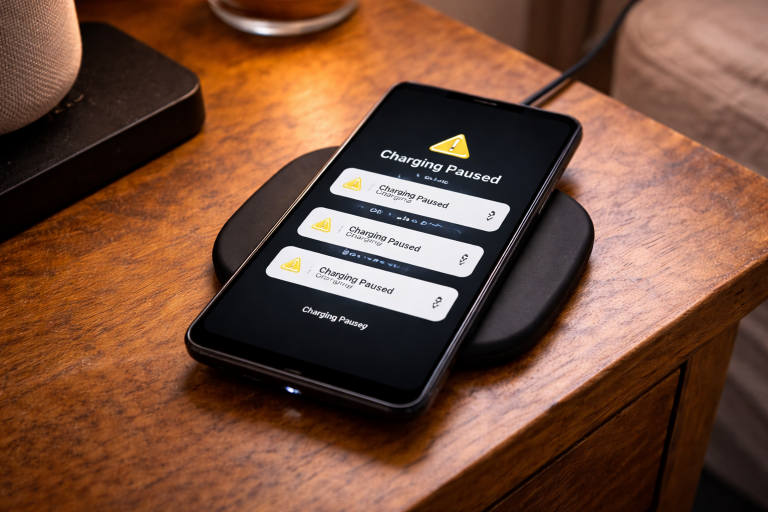
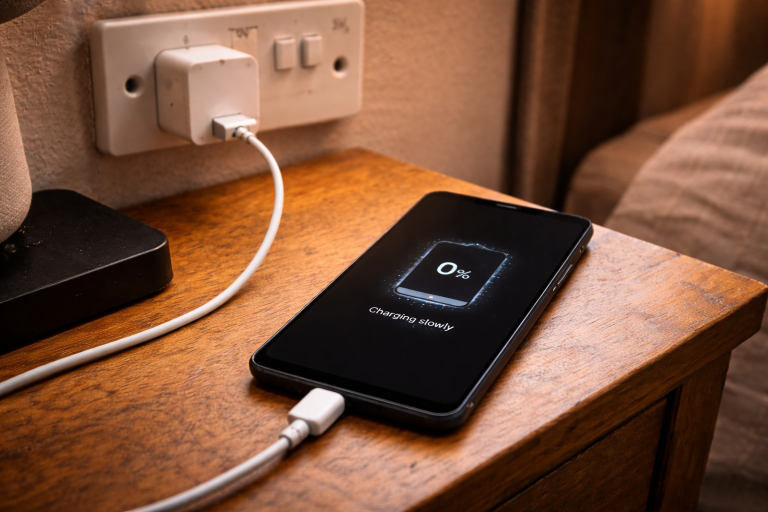
- Plug in and keep the screen awake for a while. iOS is far more willing to push large uploads when charging.
- Disable Low Data Mode on Wi‑Fi: Settings > Wi‑Fi > (i) > Low Data Mode (off).
- Check Background App Refresh (for apps that save into iCloud Drive): Settings > General > Background App Refresh.
On Macs, I’ve seen iCloud Drive appear stuck simply because the MacBook was in clamshell mode on battery and macOS decided the upload wasn’t urgent. Connect power and leave it awake.
5) Force the specific iCloud service to re-evaluate its queue
These steps are safer than signing out of iCloud and often kick the queue forward.
For Photos on iPhone/iPad:
- Open Photos and leave it on the Library screen (bottom of the library shows progress).
- Toggle iCloud Photos off and on: Settings > Photos > iCloud Photos (off), wait 30 seconds, then on. If prompted, choose to keep originals on the device if you have space.
For iCloud Drive on iPhone/iPad:
- Settings > Apple Account > iCloud > Drive > Sync this iPhone/iPad (toggle off/on).
- Force close the Files app, then reopen.
For iCloud Drive on Mac:
- System Settings > Apple Account > iCloud > iCloud Drive (toggle off/on). macOS may ask what to do with local files; read carefully.
- Restart the Mac afterwards. It sounds basic, but it resets the sync agents cleanly.
If a single file is stuck, duplicate it (or export it) and upload the duplicate. Corrupt metadata is a real thing, especially with PDFs generated by third-party scanner apps.
6) Restart the device properly (and why it matters)
A quick lock/unlock doesn’t reset the iCloud daemons. A full restart does.
- iPhone with Face ID: press Volume Up, press Volume Down, then hold Side button until the Apple logo.
- iPhone with Home button: hold Side/Top button until power off slider, then power back on.
- Mac: Apple menu > Restart.
If the device is also behaving oddly (spinning indicators, apps hanging), deal with that first. A system under memory pressure can starve sync processes. Fix iPhone stuck on the spinning loading wheel is relevant when the whole UI is lagging alongside iCloud.
7) Check Apple’s service status and the account session
- Apple’s status page can confirm outages: Apple system status and iCloud support pages.
- If status is fine but your account feels “stale”, sign out and back in only after you’ve confirmed you have local copies of anything critical.
Safer account refresh first: on iPhone, toggle Airplane Mode on for 15 seconds, off again. Then open Photos/Files and watch for progress changes.
Signing out (last resort): Settings > Apple Account > Sign Out. On Mac: System Settings > Apple Account > Sign Out. This can trigger re-downloads and re-indexing that take hours on large libraries.

8) Reset network settings (when Wi‑Fi is the repeating offender)
If uploads work on mobile data but not on your home Wi‑Fi even after forgetting/rejoining, reset network settings on iPhone:
- Settings > General > Transfer or Reset iPhone > Reset > Reset Network Settings.
This wipes saved Wi‑Fi networks and VPN profiles. It’s not subtle, but it clears broken DNS and routing state that can survive normal toggles.
Real-world scenarios that change the fix
When Photos says “Uploading” but the counter never changes
This is often a single item blocking the queue. On iPhone, scroll to the bottom of Photos and look for “Unable to Upload”. If you see it, tap for details. If you don’t, look for recently edited 4K video, Live Photos, or bursts. Those are the files that most often wedge.
What I do on a stubborn device: temporarily turn off iCloud Photos, restart, then turn it back on while on power and stable Wi‑Fi. If the same item wedges again, export that item to Files, delete it from Photos (after confirming it’s safely stored), then re-import.
When iCloud Drive is stuck on Mac but iPhone uploads fine
That points to the Mac’s local iCloud Drive database or a Finder integration issue. I’ve seen it after macOS updates where the iCloud Drive folder shows status icons but never progresses.
- Confirm the Mac has plenty of free disk space.
- Disable “Optimise Mac Storage” temporarily (System Settings > Apple Account > iCloud > iCloud Drive).
- Restart the Mac and leave it awake on power for 30 minutes.
If you’re also seeing external drive oddities, fix those separately; macOS storage pressure can cascade. Fix external SSD not detected on macOS can matter if your Photos library or working files live on an external volume.
When uploads only work overnight (or only when charging)
This is classic power/thermal gating. iOS will happily defer large uploads until it thinks conditions are “safe”: charging, cool device, stable Wi‑Fi, and minimal foreground use. If you need it to upload now, remove the constraints: plug in, turn off Low Power Mode, keep Photos open, and don’t let the phone bake under a pillow. I’ve picked up phones that were warm to the touch and watched iCloud uploads crawl until the temperature dropped.
When one device syncs and another doesn’t
That’s usually account state or time drift. Check that both devices are on the same Apple Account, have automatic date/time enabled, and have a clean network path. If the “bad” device is on a work Wi‑Fi with filtering, try a phone hotspot as a test. If it syncs instantly on the hotspot, you’ve proved it’s the network, not iCloud.
Common mistakes that keep iCloud stuck
- Assuming “Wi‑Fi connected” means “internet usable”. Captive portals and DNS issues are silent killers.
- Trying five fixes at once. You lose the ability to identify the real cause, and you can trigger re-indexing unnecessarily.
- Signing out of iCloud too early. It can create a second problem: partial local data, duplicate downloads, or days of reprocessing.
- Running with almost no free storage. Both iCloud and the device need headroom. “Other/System Data” swelling is often a symptom of stalled sync and retries.
- Leaving VPN on permanently. Some VPNs handle long-lived connections poorly; uploads restart repeatedly and look stuck.
A subtle one: people disable iCloud Drive or Photos to “stop the spinning”, then forget they did it. Weeks later they wonder why nothing syncs. Always re-check the toggles after troubleshooting.
Hardware and software factors that genuinely matter
Older iPhones and iPads under memory pressure
On devices sold before 2024, I see iCloud uploads stall more often when the device is juggling heavy apps (social video editors, games) and has limited RAM. The sync process gets killed and restarts, which looks like a stuck upload. A restart and a quiet 10 minutes on charge can do more than any setting change.
HEVC/4K video and slow upstream speeds
UK broadband often has decent download but modest upload. A few minutes of 4K video can take a long time, especially if other devices are streaming. iCloud doesn’t always show a clear “time remaining”, so it looks frozen. Test by uploading one small photo; if that completes quickly, the pipeline works and you’re just waiting on bandwidth.
iOS/macOS version mismatches
If one device is on a much older OS, certain iCloud features (especially Photos and Notes attachments) can behave inconsistently. Keep devices updated, but don’t update mid-troubleshooting if you’re already in a broken state and need the data urgently. Stabilise first, then update.
Apple’s official iCloud sync troubleshooting steps are worth checking for any service-specific quirks: official Apple iCloud sync troubleshooting.
Third-party apps writing into iCloud Drive
Some apps save temporary files into iCloud Drive and then rename them. If the app crashes mid-write, iCloud can keep retrying a half-written file. If you notice the same filename stuck, move it out of iCloud Drive (to On My iPhone/Mac), then re-save from the app.
Conclusion
iCloud “Uploading” is usually a queue that can’t complete, not a service that’s completely down. Treat it like a pipeline: confirm which service is stuck, prove whether the network path is clean, then remove power and storage constraints. Only after that should you toggle iCloud services or sign out of the account.
If you change one variable at a time, you’ll normally find the blocker quickly: a bad Wi‑Fi route, a full iCloud plan, a single corrupted file, or a device that simply refuses to upload while hot and on battery.
FAQ
Why is iCloud Photos stuck on “Uploading” only when I’m on my home Wi‑Fi but it works on 5G?
That pattern almost always points to your home network path rather than iCloud itself. Common causes are DNS issues, mesh roaming between nodes, a router security feature blocking Apple services, or a VPN/Private Relay interaction. Test by forgetting and rejoining Wi‑Fi, disabling VPN/Private Relay temporarily, and standing near the main router to avoid node switching during large uploads.
Why does iCloud Drive say “Uploading” on my Mac for hours after a macOS update but my iPhone syncs normally?
After updates, macOS can re-index files and rebuild parts of the iCloud Drive database, and that can stall if disk space is tight or the Mac sleeps aggressively. Plug the Mac into power, keep it awake, ensure you have several GB free, then restart. If the stuck item is a specific file, move it out of iCloud Drive and re-add it.
Why does iCloud upload pause when my iPhone is charging in the car but resumes at home?
Car charging often means heat plus unstable connectivity (switching between mobile cells, CarPlay sessions, or a weak in-car hotspot). iOS will throttle or pause background uploads when the device is warm or the network is inconsistent. Let the phone cool, disable Low Power Mode, and try a stable Wi‑Fi connection for large photo/video uploads.
Why does one photo or video keep iCloud Photos stuck on “Uploading” even though everything else uploads?
A single item can block the queue if its metadata is corrupt or the file is partially written. Look at the bottom of the Photos library for an “Unable to Upload” message. If it keeps returning, export or save that item elsewhere, delete it from the library (only after confirming you have a safe copy), then re-import or re-encode the video.
Does iCloud still upload properly if Low Power Mode and Low Data Mode are enabled overnight?
It can, but it’s less reliable. Low Power Mode reduces background activity, and Low Data Mode can limit network behaviour in ways that interrupt long uploads. If you need uploads to complete overnight, leave the device charging, disable Low Power Mode, and avoid Low Data Mode on the Wi‑Fi network you’re using.
Recommended gear on Amazon UK
- A stable router with decent QoS and predictable roaming reduces the stop-start upload sessions that leave iCloud stuck on “Uploading” on busy UK home networks. Comparable items
- Keeping the device on clean mains power prevents iOS from throttling background sync, which is a common reason uploads only complete when charging. Comparable items
- A reliable cable helps maintain steady charging during long upload windows, avoiding the on-off power state that can pause iCloud tasks. Relevant examples
- When a single file wedges the iCloud queue, exporting originals to fast local storage lets you delete and re-import safely without risking data loss. Relevant examples