
An Android update can land overnight and, by morning, the phone feels like it has aged five years. Apps take longer to open, the keyboard lags, scrolling stutters, and the battery seems to drop faster. On some handsets you also get heat where you never used to, especially around the camera module or top edge.
The frustrating part is that nothing “looks” wrong. Storage might still show plenty free, Wi-Fi is fine, and you haven’t installed anything new. Yet the whole device behaves like it’s constantly busy.
Most of the time, the slowdown isn’t a single bug. It’s a pile-up: post-update optimisation, app compatibility issues, storage pressure, and power/thermal management all interacting. The fix is usually a sequence of small, targeted changes rather than one magic switch.
What actually changes after an Android update (and why it feels slower)
After a major update, Android does a lot of housekeeping in the background. If you only judge performance by what happens when you tap an icon, you miss the real workload: the system is rebuilding caches, re-optimising app bytecode, re-indexing files for search, and sometimes re-scanning media. That work competes with your apps for CPU time, storage I/O, and memory.
On modern Android, app code is compiled and optimised ahead of time for your specific device. After an update, that optimisation can be invalidated and rebuilt. When the phone is on charge and idle, it tries to catch up. If you updated and then immediately started using the phone heavily (maps, camera, social apps), you can end up “sharing” the device with its own maintenance tasks.
Another common culprit is storage behaviour. Android is sensitive to free space, but not in the simplistic “0% free means slow” way. When internal storage is close to full, the system has less room for temporary files, app updates, and cache churn. The result is stutter, longer app launches, and sometimes random app reloads because memory management becomes more aggressive.
Then there’s thermal and power management. Updates can change how the kernel schedules tasks, how aggressively it boosts CPU frequencies, and how it throttles when warm. I’ve seen phones that were fine on Android 13 start throttling earlier on Android 14, simply because the vendor tuned for battery life and sustained performance differently.
Finally, app compatibility. Some apps behave badly after an OS update: stuck background services, repeated crash loops, or a sync job that never finishes. If you’ve ever watched a phone feel “busy” while doing nothing, it’s often one or two apps hammering the system.
A practical troubleshooting run that doesn’t waste your time
Work through this in order. The early steps are low-risk and often fix the issue without resets. Don’t skip straight to factory reset unless you’ve already confirmed the basics.
1) Confirm it’s not just post-update optimisation
The failure mode: the phone is slow for 24–72 hours after the update, then gradually improves. People wipe the device on day one and never find out it would have settled.
- Leave the phone on charge for 1–2 hours with the screen off and Wi-Fi on.
- Restart once after that idle period.
- Use it normally for 10 minutes and see whether the lag is consistent or only during the first app launches.
In practice, this step fixes the problem in about half of cases where the update was installed late at night and the phone was used heavily the next morning.
2) Check storage the way Android feels it, not the way the number looks
The failure mode: you have “8GB free” on a 128GB phone and assume you’re safe. Many devices still stutter at that level because of how apps and media caches expand.
- Go to Settings > Storage.
- If free space is under 10–15%, treat it as a performance issue.
- Clear large, low-value space first: downloaded videos, offline maps, old podcasts, WhatsApp media, and duplicate photos.
- Empty the bin/trash in your gallery app if it has one.
What I see a lot on UK devices sold before 2024 is storage pressure caused by messaging apps quietly accumulating media. The phone isn’t “full” until it suddenly is, and the update just makes the tipping point obvious.
3) Identify the app that’s chewing CPU or battery since the update
The failure mode: one app goes rogue after the OS update, and the rest of the phone gets blamed.
- Open Settings > Battery > Battery usage (wording varies by brand).
- Look for an app with unusually high usage since last full charge, especially if you haven’t used it much.
- Tap the app and check whether it’s running in the background heavily.
If an app is clearly abnormal:
- Force stop it.
- Update it in the Play Store.
- If it’s still misbehaving, clear its cache (next step) or uninstall/reinstall.
If you’re seeing crashes alongside slowness, the pattern often overlaps with app update issues. The troubleshooting flow in Fix apps crashing after updates on Android pairs well with the steps below.
4) Clear cache for the worst offenders (without nuking your data)
The failure mode: after an update, an app’s cache becomes incompatible or bloated, causing slow launches, UI lag, or repeated background work.
- Go to Settings > Apps > See all apps.
- Start with heavy apps: Chrome, Instagram, TikTok, Facebook, WhatsApp, YouTube, Google Photos, your launcher.
- Open each app > Storage & cache > Clear cache.
Avoid Clear storage unless you’re prepared to sign back in and potentially lose local downloads. Cache clearing is the safe lever.
5) Restart properly (and don’t rely on “optimisers”)
The failure mode: the phone has been “restarted” via quick toggles or partial power cycles, leaving services in a bad state.
- Hold the power button and choose Restart (not just screen off).
- If your phone has it, use Restart rather than Power off then on; some brands do extra service resets on restart.
Skip third-party “RAM booster” apps. They tend to create the exact background churn that makes a post-update phone feel worse.
6) Disable or remove recently updated apps that now behave differently
The failure mode: a major OS update coincides with a major app update, and you blame the OS. I’ve watched this happen with launchers, VPNs, accessibility tools, and battery savers.
- In the Play Store, check Manage apps & device > Manage > sort by Recently updated.
- Temporarily uninstall non-essential apps updated around the same time as the OS update.
- Reboot and test performance for 10–15 minutes.
If performance snaps back, reinstall apps one-by-one. It’s tedious, but it’s the fastest way to catch a single bad actor.
7) Check for a second update (patches often follow within days)
The failure mode: you installed the big update, but the vendor already shipped a hotfix for performance or battery drain.
- Go to Settings > System > Software update.
- Install any follow-up patch.
- Also update Google Play system update (often under Security).
Google’s own notes on system updates and device performance are worth scanning when behaviour changes after a patch: Google support: Android updates and device performance.
8) Reset network settings only if the “slowness” is actually network stalls
The failure mode: apps feel slow because they’re waiting on DNS, Wi‑Fi roaming, or a broken VPN profile. The UI is fine; content loads late.
- Test with mobile data vs Wi‑Fi.
- Disable any VPN or private DNS temporarily.
- If the issue is clearly network-related, use Reset Wi‑Fi, mobile & Bluetooth (wording varies).
Be aware this wipes saved Wi‑Fi networks and Bluetooth pairings. It’s not a performance reset; it’s a connectivity reset.
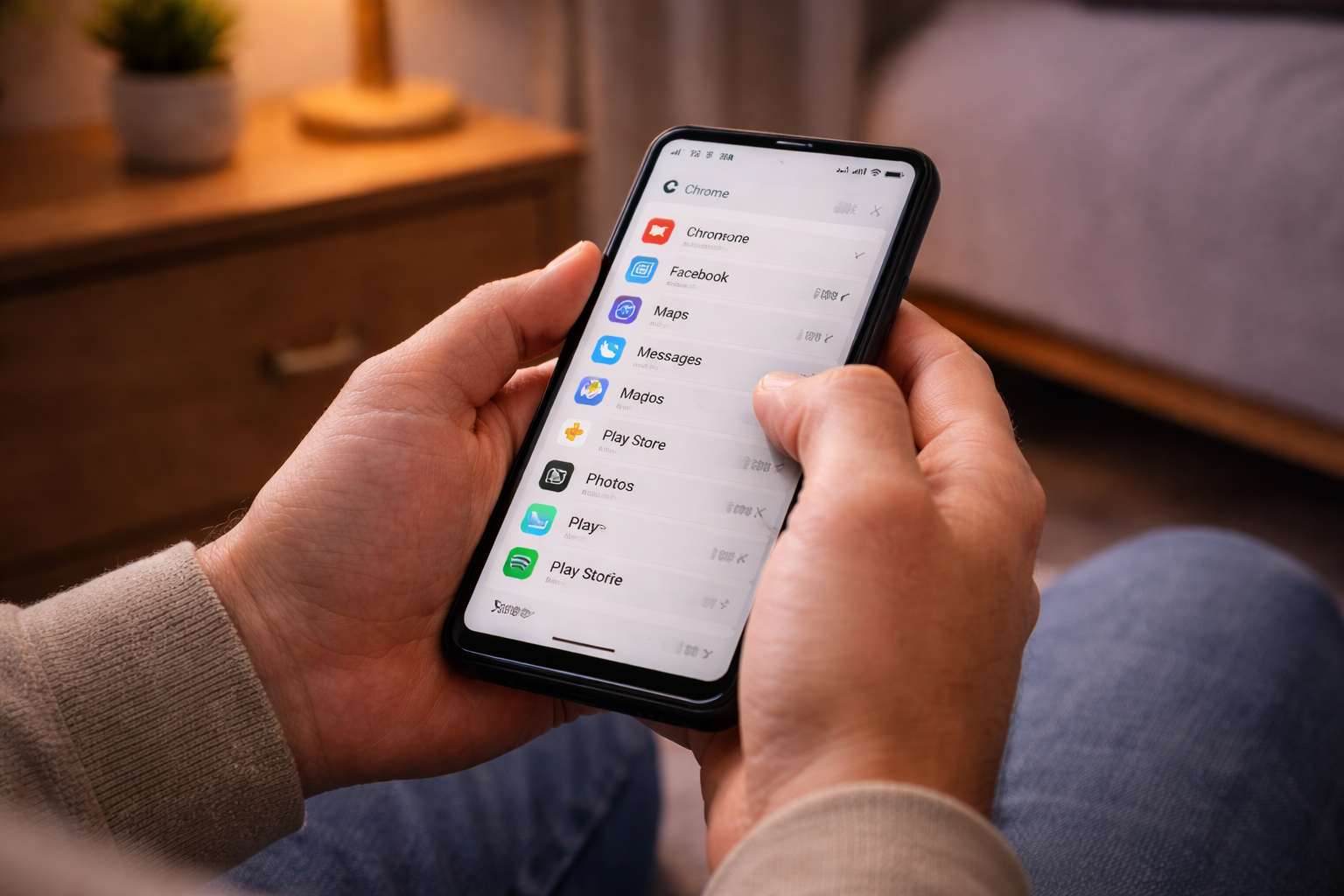
9) Boot into Safe Mode to prove whether it’s a third-party app problem
The failure mode: you keep clearing caches and toggling settings, but a third-party app or launcher is still causing lag.
- Press and hold the power button to open the power menu.
- Press and hold Power off until Safe mode appears (most Android skins).
- Confirm and let the phone reboot.
- Test scrolling, app switching, keyboard responsiveness, and camera launch speed.
If the phone is smooth in Safe Mode, the OS itself is usually fine. The culprit is a third-party app, launcher, keyboard, VPN, or accessibility service. This is the point where I stop guessing and start uninstalling in batches.
10) Wipe the system cache partition (only where it exists)
The failure mode: on some devices, stale system cache contributes to odd lag after updates. On many modern phones, this option is gone or does nothing meaningful.
Samsung and a few others still expose recovery options that can help. If your recovery menu offers wipe cache partition, it’s worth trying once. If it doesn’t exist, don’t go hunting for sketchy tools.
Vendor steps vary, but Samsung’s official support pages are the safest reference for their recovery options: Samsung support: recovery mode and cache partition guidance.
11) Factory reset: only after you’ve proved it’s not a single app
The failure mode: a reset is used as a first resort, then the same apps and settings are restored and the lag returns.
- Back up properly (photos, messages, authenticator codes, banking apps).
- Reset the phone.
- Set up without restoring a full app backup initially.
- Test performance on a clean baseline for an hour.
- Reinstall apps gradually, starting with essentials.
I’ve had devices come in where the reset “didn’t work”, but the owner restored an old launcher layout, an aggressive battery saver app, and a VPN profile within 10 minutes. The reset did work; the restore reintroduced the problem.
Performance problems I see in the real world (and what they usually turn out to be)
“The keyboard is laggy, but only in WhatsApp and Chrome.” That’s often a keyboard app issue (Gboard update, Samsung Keyboard bug, or a third-party keyboard). Clearing cache for the keyboard and the affected apps helps. If not, switch keyboards for a day to test.
“It’s smooth until I open the camera, then everything slows down.” Camera apps can trigger thermal load fast, especially if HDR processing changed after the update. If the phone gets warm quickly, you’re seeing throttling. Remove thick cases temporarily and test again. I’ve seen this most often on mid-range phones where the update enables heavier processing by default.
“Battery drain and slowness started together.” That’s usually background activity. Battery usage will often show the offender, but not always. Safe Mode is the cleanest proof. If Safe Mode fixes it, don’t waste time on animation tweaks.
“Only the home screen stutters; apps are fine.” Launcher problems. Updates can break icon packs, widgets, or accessibility overlays. Try removing widgets first (weather widgets are repeat offenders), then test a different launcher. If you’re using a third-party launcher, update it or temporarily switch back to the stock launcher.
“It’s slow on Wi‑Fi but fine on 4G/5G.” That’s not an OS performance issue. It’s DNS, router behaviour, or a Wi‑Fi power-save quirk introduced by the update. Toggling private DNS off for a test is a quick tell.
Errors that make the slowdown stick around
- Clearing “storage” instead of “cache” and then assuming the app is broken. You’ve wiped local data and forced a full resync, which can make the phone busier for hours.
- Installing multiple “cleaner” apps to fix lag. They keep services alive, scan constantly, and fight Android’s own memory management.
- Restoring everything immediately after a reset. If you restore a problematic app set, you’ve learned nothing and you’re back where you started.
- Ignoring heat. If the phone is warm, performance will be capped. People chase software fixes while the device is throttling because it’s charging under a pillow.
- Assuming the update “ruined the phone” when storage is at 95% and the device is indexing 40,000 photos. The update didn’t create the workload; it exposed it.
Device-level factors that change what “slow” means
Thermal headroom. Thin phones with compact cooling will throttle sooner after updates that increase background work or camera processing. If performance drops mainly when charging, gaming, or using the camera, treat it as thermal first.
UFS vs eMMC storage. Older budget phones with eMMC storage can feel dramatically worse after updates because random I/O is slower. When the system is compiling apps and updating databases, eMMC devices show it as stutter. You can’t “tune” your way out of slow storage; you can only reduce background load and keep free space high.
RAM size and memory pressure. 4GB devices are far more sensitive to heavy apps and widgets. After updates, apps may use more memory (new features, heavier web views). The symptom is app reloads and keyboard lag when switching tasks.
Battery health and power limits. Some Android skins reduce peak performance when battery health is poor or when the battery is cold. I’ve seen phones that feel fine at 60% charge but lag badly below 15% because power delivery sags and the system clamps performance.
Vendor skin behaviour. Samsung One UI, Pixel UI, Xiaomi HyperOS, and others all schedule background work differently. A fix that helps on a Pixel (like disabling an always-on feature) might do nothing on a Samsung, where the launcher and device care services behave differently.
Closing notes from the bench
If an Android phone is slow after an update, assume background work and app conflicts first, not “the update is broken”. Get storage comfortably clear, identify any app that’s suddenly busy, and use Safe Mode to stop guessing. Once you’ve proved whether it’s system-wide or app-driven, the remaining steps become obvious.
When the slowdown persists beyond a few days and survives Safe Mode, you’re usually looking at a vendor bug fixed by a follow-up patch, or a device that was already near its limits (storage, RAM, thermals) and now has less margin. At that point, a clean reset without restoring everything at once is the only test that gives a trustworthy baseline.
FAQ
Why is my Android phone slower only after the update when it’s charging overnight on my bedside table?
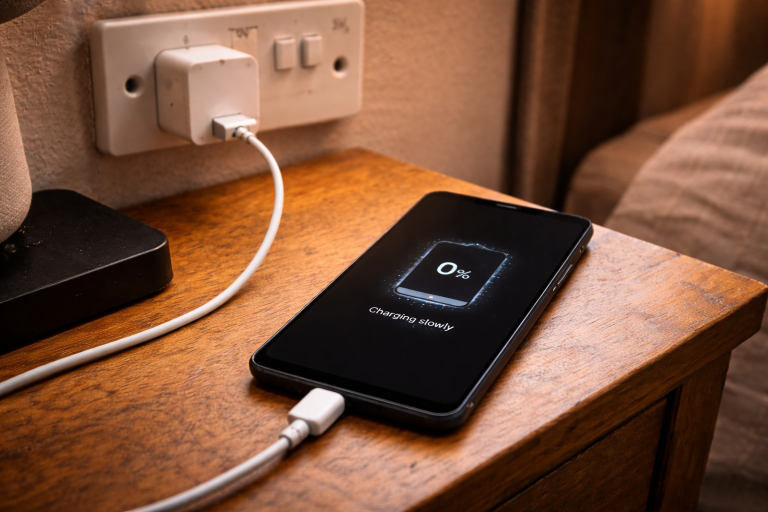
Charging plus background optimisation is a common combination: the phone uses that time to recompile apps, index photos, and run deferred sync jobs, which can leave it warm and throttled by morning. If it’s also charging on a soft surface that traps heat, performance can stay capped for a while. Try one night on a hard surface with the case off, and leave it idle on charge for an hour after the update to let it finish its maintenance.
Why does my Android feel smooth in Safe Mode but laggy again as soon as I reboot normally after the update?
Safe Mode disables third-party apps and most overlays, so smooth performance there strongly points to an installed app, launcher, keyboard, VPN, or accessibility service. Start by uninstalling recently updated apps and removing widgets, then reboot normally and test. If you use a third-party launcher, switch back to the stock launcher for a day to confirm.
After an Android update, why do apps take ages to open even though I still have several GB free storage?
Several GB free can still be “low” depending on total capacity and how the phone manages temporary space. When storage is tight, database writes and cache churn slow down, and app launches suffer because the system is doing more I/O work per action. Aim for 10–15% free space, clear large media caches, and empty gallery trash to restore headroom.
Why does my Android phone get hot and stutter after the update only when I open the camera or record video outdoors?
Camera processing is one of the fastest ways to hit thermal limits, and updates can change HDR, stabilisation, or encoding behaviour. Outdoors, higher screen brightness and warmer ambient temperature reduce cooling headroom, so the phone throttles and the UI stutters. Test with the case off, close background apps, and lower video settings temporarily to see if heat is the trigger rather than a general performance fault.
Does clearing app cache after an Android update delete my photos, messages, or banking app data?
Clearing cache should not delete your personal data; it removes temporary files the app can rebuild. Clearing storage (or data) is different and can sign you out, remove downloads, and reset app settings. If you’re unsure, clear cache first and only clear storage for a specific app when you’re prepared to set it up again.
Recommended gear on Amazon UK
- A stable PD/PPS charger reduces slow charging and excess heat during post-update optimisation, which helps avoid thermal throttling that feels like lag. See suitable options
- A proper e-marked cable prevents flaky charging and repeated reconnect behaviour that can keep the phone warm and busy in the background after an update. Comparable items
- Offloading large videos and downloads quickly frees internal storage headroom, which directly improves app launch times and reduces stutter on storage-sensitive phones. See suitable options
- If the update makes the phone run warmer under load, a less insulating case can reduce throttling during camera use, charging, and heavy scrolling. Relevant examples


1 thought on “Fix Android Phone Running Slow After Update”